
Entity-Based SEO Explained for Beginners
Search engines have changed a lot. A few years ago, you could publish a page, repeat the same keyword in the title, headings, and paragraphs, build some backlinks, and often rank. That still works sometimes, but it’s no longer the smartest strategy—especially if you want stable rankings and long-term growth.
Today, Google is much better at understanding language. It tries to understand what a page is actually about, what concepts it covers, and how those concepts relate to each other. That’s where Entity-Based SEO becomes powerful.
Entity-based SEO is not a “new trick.” It’s a shift in how you structure content and how you communicate meaning. Instead of writing only for a keyword, you write for the topic, the entities inside the topic, and the relationships between them. When you do it well, your content can rank for dozens (sometimes hundreds) of related queries—even if you don’t intentionally target each one.
This guide explains entity-based SEO from beginner to advanced level, with examples you can use immediately.
1) What Is Entity-Based SEO?
Entity-Based SEO is the practice of optimizing content around entities, not just keywords.
- A keyword is a phrase someone types into Google.
Example: “best laptop for graphic design” - An entity is a specific “thing” Google can identify and understand as a unique concept.
Examples: “Adobe Photoshop,” “RAM,” “GPU,” “MacBook Pro,” “color accuracy,” “Kathmandu,” “schema markup,” “technical SEO.”
Google treats entities as meaningful objects. It can connect them, compare them, and understand how they relate. When your content includes the right entities (in a natural way), Google can understand your page more clearly.
Why this matters
When Google understands your page deeply, it can show it for many related searches. You aren’t limited to one exact keyword anymore.
So entity-based SEO is not about writing robots-friendly content. It’s about writing human-friendly content that search engines can interpret accurately.
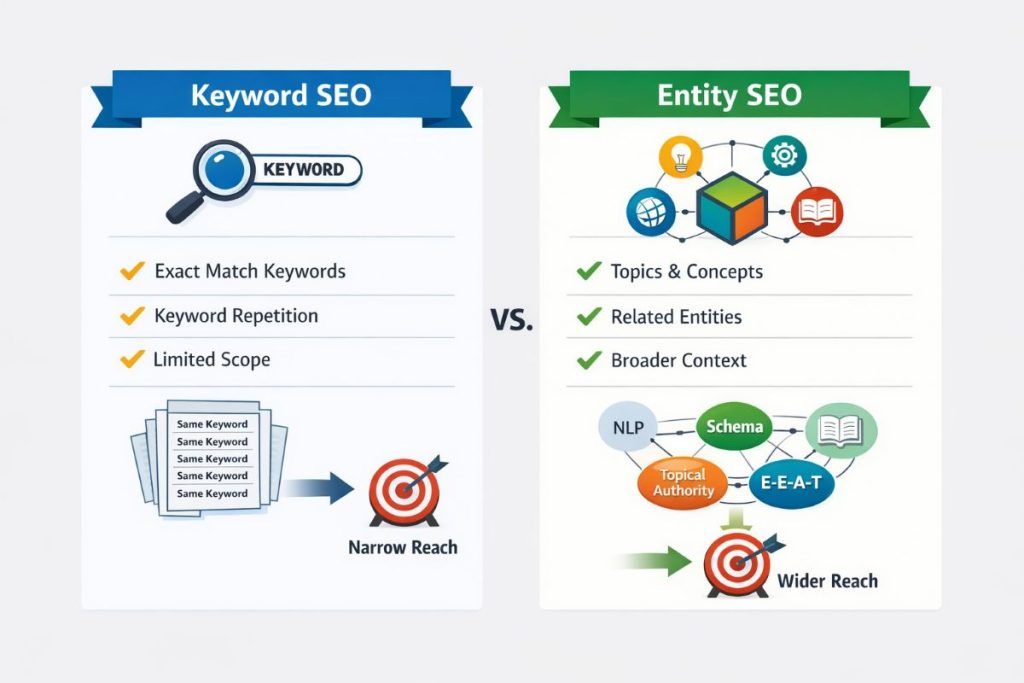
2) Keywords vs Entities (The Real Difference)
Let’s make the difference simple.
Keyword SEO (old style)
You pick one keyword like:
“Entity Based SEO”
Then you try to use it:
- in the title
- in the meta description
- in H1/H2
- in the first 100 words
- repeatedly in the body
This can create awkward writing and unnatural repetition.
Entity SEO (modern style)
You pick the topic, then you cover:
- the definition
- the components
- related concepts
- examples
- use cases
- common mistakes
- supporting subtopics
Google understands: “This page is a complete guide about this topic.” That’s the goal.
Entity SEO still includes keywords, but naturally. The writing doesn’t feel forced, and you don’t worry about repeating the same phrase again and again.

3) What Counts as an Entity? (Beginner-Friendly)
Entities are not only people or brands. In SEO content, entities can be:
People, brands, organizations
- Google, WordPress, Elementor, Semrush, Ahrefs, Yoast
- Apple, Dell, ASUS, Lenovo
Places
- Nepal, Kathmandu, Pokhara, Lalitpur
Concepts (very important for SEO)
- Search intent
- Topical authority
- Semantic search
- Knowledge graph
- E-E-A-T
- Crawlability
- Indexing
- Canonical tags
- Structured data / Schema markup
Attributes / features
- RAM, GPU, Core Web Vitals, LCP, CLS, TTFB
- Page speed, mobile usability
In entity-based SEO, your content becomes stronger when it naturally includes the correct supporting entities that belong to the topic.
4) How Google Understands Entities (Simple Explanation)
Google uses Natural Language Processing (NLP) to extract meaning from text. When it reads your article, it tries to answer questions like:
- What is the main topic of this page?
- Which related concepts are included?
- Does the content explain them well?
- Is the content trustworthy?
- Does it match what the searcher wants?
Google can also connect entities using its knowledge systems (often called the Knowledge Graph). You don’t need to be an expert in the Knowledge Graph, but you should understand this idea:
Google is building a map of how concepts relate to each other, and it ranks pages that explain those concepts clearly.
That’s why entity SEO works so well: it aligns your content with how Google processes meaning.
5) The Core Benefit: Ranking Without Targeting Every Keyword
One of the biggest advantages of entity-based SEO is that you can rank for many searches without writing separate articles for each tiny keyword.
For example, if you write a strong guide about “WordPress speed optimization,” and you cover relevant entities like:
- caching
- CDN
- image compression
- lazy loading
- database optimization
- Core Web Vitals (LCP, CLS, INP)
- plugins (LiteSpeed, WP Rocket)
- hosting (server response time)
Then your page can show up for searches like:
- “how to improve LCP in WordPress”
- “best caching plugin for WordPress”
- “how to reduce CLS”
- “optimize images for WordPress”
- “TTFB too high WordPress fix”
You didn’t stuff these keywords. You simply covered the topic properly, and Google connects your content to related queries.
6) Entity Research: How to Find the Right Entities (Step-by-Step)
You don’t need expensive tools at the beginning. You can do entity research using free sources.
Step A: Use Google Autocomplete
Type your main topic and see suggestions.
Example: type “Entity SEO”
You might see:
- entity SEO meaning
- semantic SEO
- knowledge graph SEO
- entity salience
- schema markup
Those are supporting concepts you should consider.
Step B: Check “People Also Ask”
Open a few questions, expand them. These questions show what users want, and the terms inside them often reveal key entities.
Step C: Look at Related Searches
Scroll to the bottom. Google shows related topics because they are connected.
Step D: Study Competitor Headings
Open the top 3–5 ranking pages and look at:
- H2s and H3s
- what they explain
- what examples they give
Don’t copy the content. Copy the coverage idea. If all top pages include “schema markup,” it’s probably an important entity in the topic.
Step E: Use Wikipedia (for brand or concept clarity)
If your topic includes known organizations, people, or concepts, Wikipedia can help confirm correct terms and related concepts.
7) Content Structure: The Entity-First Outline (This Improves Flow)
Most content writing feels “not flowing” because the outline is weak.
A strong entity-based article uses a structure like this:
- Hook + problem (why the reader should care)
- Clear definition
- Why it matters (benefits)
- How it works (simple explanation)
- Core components (supporting entities)
- Step-by-step process (how to implement)
- Real examples
- Mistakes to avoid
- FAQs
- Conclusion + next steps
This structure naturally creates flow and reads like a human guide.
8) Entity Salience (Advanced, but Important)
Entity salience means: Which entities feel most important in your content?
Google tries to guess:
- what’s central vs what’s just mentioned
- what the page truly focuses on
To increase salience of an important entity:
- use it in headings (when appropriate)
- define it clearly
- explain why it matters
- show an example
- connect it to the main topic
- link to deeper related content on your site
This is why adding a word once is not enough. If you want Google to see “schema markup” as important, you must explain it meaningfully.
9) Example: Building an Entity-Based Article (Real Demonstration)
Let’s build a mini version of an article using entity SEO.
Topic: “SEO Audit for Beginners”
Core entity: SEO audit
Supporting entities:
- crawl errors
- index coverage
- site structure
- internal links
- title tags and meta descriptions
- Core Web Vitals
- robots.txt
- sitemap
- canonical tags
- thin content
- duplicate content
- backlinks
Now, look at how we write a paragraph naturally:
Example paragraph:
An SEO audit is basically a health check of your website. It helps you find issues that block search engines from crawling and indexing your pages properly. For example, if your sitemap is missing important URLs, or your robots.txt blocks sections of your site, Google might not discover your content at all. On the content side, an audit also looks for thin pages, duplicated articles, and missing metadata—problems that can reduce rankings even when your design looks perfect.
Notice: we didn’t repeat “SEO audit” 20 times. But Google can clearly understand the topic because related entities are strong and relevant.
10) Internal Linking: The Hidden Engine of Entity SEO
Entity SEO becomes powerful when your site is organized like a “knowledge hub.”
Instead of publishing random posts, you create clusters.
Example cluster for “Entity-Based SEO”
- Pillar: Entity-Based SEO guide
- Support articles:
- Semantic SEO explained
- What is the Knowledge Graph?
- Schema markup beginner guide
- Topical authority and topic clusters
- How Google understands search intent
Then you interlink them. Now Google sees:
- your website covers this topic deeply
- your content is connected logically
- you are building authority
This improves rankings faster than publishing isolated posts.
11) Schema Markup: How It Supports Entities
Schema markup is structured data that helps Google understand:
- what type of page it is
- who wrote it
- what organization it belongs to
- FAQs, breadcrumbs, product info, reviews, etc.
For entity SEO, schema is like “metadata clarity.”
Good starting schemas:
- Article schema
- Organization schema
- Person schema
- Breadcrumb schema
- FAQ schema
Important note: schema helps, but it won’t fix weak content. Entity SEO begins with strong writing and topic coverage.
12) Real-World Example: “Best Laptop for Graphic Design” (Full Entity Approach)
Let’s do a stronger example.
Core entity: Laptop for graphic design
Supporting entities:
- Adobe Photoshop, Illustrator
- RAM (16GB baseline)
- GPU (for acceleration)
- CPU (multi-core performance)
- SSD (fast file loading)
- Display (color accuracy, brightness)
- sRGB / AdobeRGB
- Thermal performance
- Battery life
- Budget in Nepal (NPR)
- Brand models
Now we create sections that flow:
Section: Performance needs (CPU + RAM + GPU)
Graphic design doesn’t always require an extreme gaming GPU, but performance still matters—especially if you work with high-resolution images, large PSD files, or dozens of layers. Programs like Photoshop rely heavily on RAM and fast storage when switching between layers, applying filters, or working with smart objects. For most designers, 16GB RAM is a safe starting point, while 32GB becomes useful if you handle heavy projects or multitask with multiple Adobe apps open.
Section: Display quality (color accuracy)
A laptop can be powerful, but if the display is inaccurate, your design work can suffer. Color accuracy matters because what you see on your screen should match what clients and audiences see on other devices. Look for screens that cover a strong percentage of sRGB, with good brightness and consistent viewing angles. This is especially important for branding, product design, and social media creatives where color consistency builds trust.
See how the content feels like a real guide, not SEO text? That’s entity SEO.
13) Mistakes That Kill Flow (And How to Fix Them)
Mistake 1: Writing without an outline
Fix: Create H2/H3 first, then write.
Mistake 2: Jumping between topics randomly
Fix: Use transitions like:
- “Now that we understand X, let’s look at Y.”
- “The next part is important because…”
Mistake 3: Stuffing terms without explaining
Fix: Every important term should have:
- 1–2 sentence definition
- why it matters
- example
Mistake 4: No examples
Fix: Add practical scenarios:
- audits
- case studies
- checklists
14) How to Write Entity-Based Content That Feels Human
Here’s a simple writing rule:
Explain it like you’re teaching a beginner friend, then add expert depth.
Use:
- short sentences in tough sections
- longer paragraphs for storytelling
- examples and analogies
Also, avoid “SEO filler lines” like:
- “In today’s digital world…”
- “SEO is very important…”
Instead:
- start with a problem and solution
- make it actionable
15) Beginner Action Plan (7 Days)
Day 1: Choose one main topic
Day 2: Collect 20–30 related entities (Google + competitor headings)
Day 3: Build a clean outline
Day 4: Write with definitions + transitions
Day 5: Add examples + visuals idea (optional)
Day 6: Add internal links + FAQ
Day 7: Edit for clarity (remove repetition)
FAQs
1) Do I need paid tools for entity SEO?
No. Google search features are enough to start.
2) Does entity SEO replace keyword research?
No. Keyword research shows demand; entities help you cover meaning and depth.
3) Is schema mandatory?
Not mandatory, but helpful for clarity and rich results.
4) What’s the fastest win?
Build one pillar page + 4–6 supporting articles and interlink them.
Conclusion
Entity-based SEO is the difference between writing content that targets one keyword and writing content that builds true authority. When you focus on entities, you create pages that cover the topic completely, in a way that feels human and useful. Google understands your content better, users stay longer, and over time your rankings become more stable.
Instead of chasing hundreds of keywords, you build a knowledge network—one strong topic cluster at a time.