
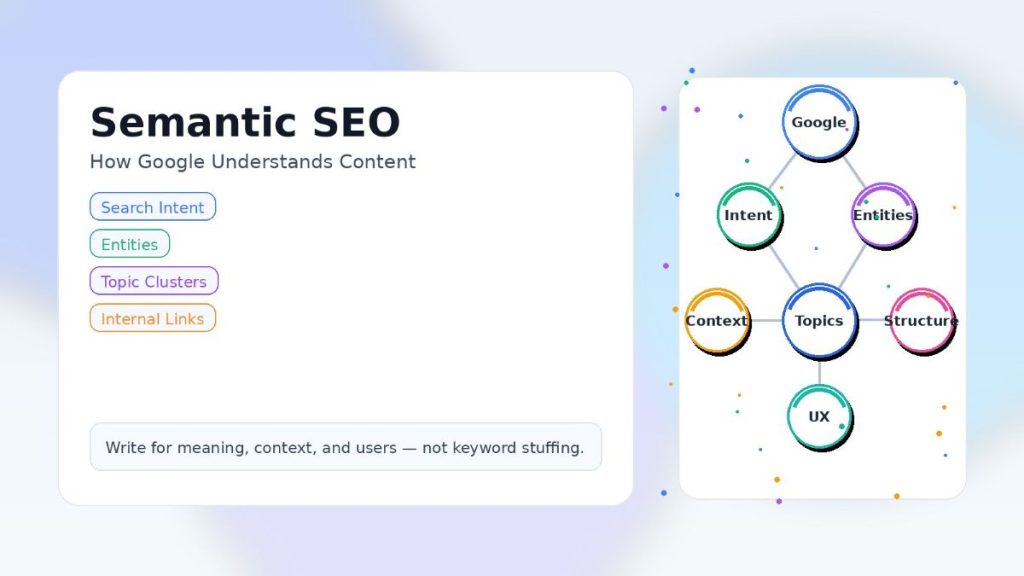
Semantic SEO: How Google Understands Content
If you want your article to rank today, writing only around one keyword is not enough.
Google has become much better at understanding meaning, context, and search intent. Google’s own documentation explains that Search is an automated system that crawls, indexes, and ranks pages, and that SEO helps search engines crawl, index, and understand your content more effectively.
That is where Semantic SEO comes in.
Semantic SEO is not about tricking Google. It is about writing content in a way that:
helps users understand the topic clearly
helps Google understand what your page is about
answers the real intent behind a search
covers related subtopics naturally
avoids keyword stuffing
And yes — this is exactly the kind of content style Google encourages: helpful, reliable, people-first content created for users, not just for rankings.
What Is Semantic SEO?
Semantic SEO means optimizing content around topics, intent, and relationships between ideas, not just repeating one keyword.
Simple definition
Instead of writing an article only for:
- “semantic seo”
you write a page that also naturally covers:
- how Google understands content
- search intent
- entities
- topic relationships
- internal linking
- structured data
- content depth
- examples and FAQs
This helps your page become more complete and more useful.
Old SEO vs Semantic SEO
Old keyword-focused style
- Repeat the exact keyword many times
- Force keywords into every heading
- Write for bots first
Semantic SEO style
- Cover the topic deeply
- Use related terms naturally
- Answer the user’s real question
- Write for humans first
That shift is the key to modern content writing.
Why Semantic SEO Matters
Google Search is not a simple “exact keyword matching” machine. It crawls pages, processes content, and decides what to show based on many ranking systems and signals. Google also says there is no payment shortcut for crawling or ranking, and no guarantee of indexing/ranking even if a page follows best practices.
So what gives you a better chance?
A page that is:
- clear
- useful
- well-structured
- relevant to intent
- easy for Google to understand
Benefits of semantic SEO
When you write semantically strong content, your page can:
- rank for more related search queries
- match multiple variations of user searches
- build topical authority
- improve internal linking opportunities
- increase time on page (because the content is actually helpful)
- reduce bounce from poor intent match
This is also aligned with Google’s people-first content guidance. Google explicitly says its ranking systems aim to prioritize helpful, reliable information created to benefit people.
How Google Understands Content (Practical View)
Google does not reveal every ranking detail, but Google Search Central and Search documentation give us a clear framework for how content is discovered and interpreted.
Here is the practical explanation.
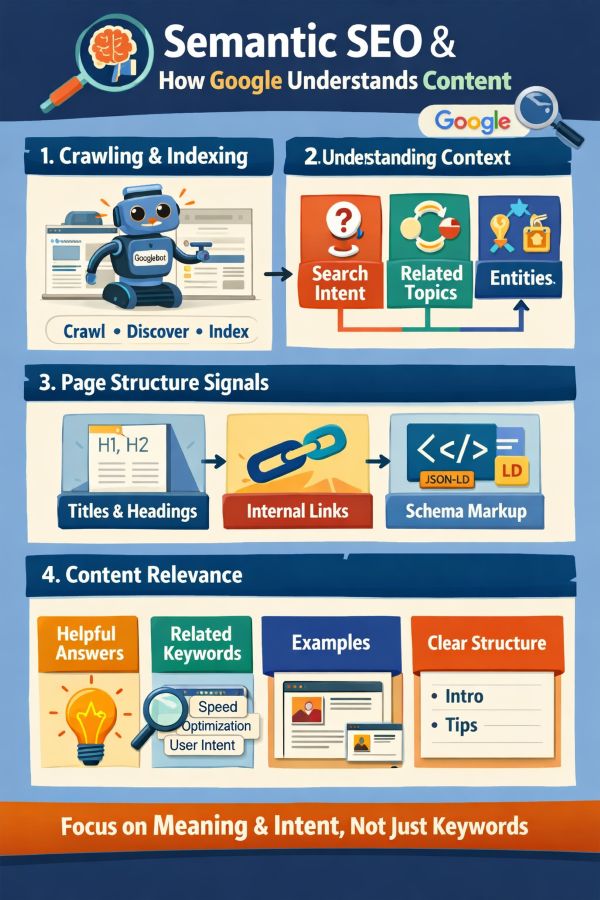
1) Google Crawls and Reads Your Page
Google uses web crawlers (like Googlebot) to discover pages on the web and add them to the index. Most pages are found automatically through crawling, especially via links.
That means your content must be:
- accessible
- crawlable
- linked properly
- not blocked unnecessarily
If Google can’t crawl the page properly, even great content may struggle.
2) Google Tries to Understand Meaning, Not Just Exact Words
Google Search is much better now at understanding related phrasing and topic context.
For example, if someone searches:
- “how to improve website speed”
Google can understand pages using phrases like:
- speed optimization
- page load time improvements
- performance tuning
- Core Web Vitals fixes
This is why exact-match repetition is not necessary.
Example (bad writing)
Semantic SEO is important because semantic SEO improves semantic SEO and helps semantic SEO rankings.
Better (semantic writing)
Semantic SEO improves rankings by helping Google understand your page’s topic, intent, and context instead of relying only on repeated keywords.
Same topic. Better readability. Better meaning.
3) Google Uses Page Structure to Interpret Your Content
Google’s SEO Starter Guide emphasizes helping search engines understand content, and also explains the value of good link text (anchor text) because it tells users and Google what the linked page is about.
Your page structure gives strong semantic signals, including:
- Title tag
- H1
- H2/H3 headings
- Paragraph flow
- Internal links
- Anchor text
- Image alt text
- Schema markup (if relevant)
A messy page with weak headings is harder to interpret.
A clean page with logical sections is easier for both users and Google.
4) Google Understands Search Intent
Search intent is the reason behind the query.
Two users may type similar words but want different things.
Example: “SEO audit”
Possible intents:
- “What is an SEO audit?” (informational)
- “SEO audit checklist” (practical/informational)
- “SEO audit service near me” (commercial/local)
- “Free SEO audit tool” (tool/commercial)
If your page is a sales pitch but the user wants a guide, your page may not perform well.
Semantic SEO works because it starts with intent:
- What is the user trying to learn, solve, or do?
5) Google Understands Entities and Relationships
In SEO, an entity is a clearly identifiable thing (person, brand, place, concept, product, etc.).
Examples:
- Google (company)
- Kathmandu (location)
- WordPress (software)
- SEO audit (concept/service)
Semantic SEO improves when your article makes entity relationships clear.
Example
If your article mentions “Apple,” Google needs context:
- Apple the company?
- apple the fruit?
You clarify this by adding related terms:
- iPhone, MacBook, Tim Cook (company context)
- nutrition, fiber, fruit, vitamins (food context)
This is semantic context in action.
6) Google Can Use Structured Data to Understand Content Better
Google Search Central explains that structured data helps Google understand page content and may make pages eligible for rich results (when guidelines are followed). Google also documents technical and quality guidelines for structured data, and recommends formats like JSON-LD.
Important point:
- Structured data helps understanding
- It does not guarantee rankings or rich results
For article pages, Article schema is often useful.
For local services, LocalBusiness schema may be useful.
For FAQs, use FAQPage only when it fits the page and follows current Google rules.
Semantic SEO vs Keyword Stuffing
This part is very important for content writing.
What is keyword stuffing?
Keyword stuffing means forcing the same phrase repeatedly in unnatural ways.
Example:
Best semantic SEO article for semantic SEO writing because semantic SEO article helps semantic SEO strategy with semantic SEO tips.
That is not helpful writing.
It looks spammy, feels robotic, and reduces trust.
Google’s people-first content guidance clearly supports content created to help users, not content made mainly to manipulate rankings.
What semantic SEO looks like instead
Semantic SEO uses:
- natural language
- related terms
- examples
- subtopics
- clear headings
- question-answer structure
- internal links to relevant content
Example (better)
A strong semantic SEO article covers more than a single keyword. It explains the topic clearly, matches search intent, uses related concepts naturally, and answers follow-up questions readers are likely to ask.
This is better content for users and easier for Google to understand.
Core Principles of Semantic SEO Writing
To write high-quality semantic content, follow these principles.
1) Start with the topic, not only the keyword
A keyword is just a starting point.
For your article, the keyword might be:
- semantic SEO
But the topic is bigger:
- How Google understands content and how to write semantically rich articles
That bigger topic helps you build a stronger structure.
2) Understand search intent before writing
Ask:
- Is the reader a beginner?
- Do they want examples?
- Do they want a checklist?
- Do they want technical details?
- Are they trying to apply this to their website?
For your request, the intent is:
- educational + practical + website-ready article
So the article should include:
- definition
- explanation
- examples
- writing rules
- FAQ
- publish-ready structure
3) Cover the topic in layers
A strong article usually answers:
- What is it?
- Why does it matter?
- How does it work?
- What are examples?
- How do I apply it?
- What mistakes should I avoid?
- What questions do people still ask? (FAQ)
This layered format makes the article complete.
4) Use related terms naturally
You do not need to force “fancy SEO words.”
Use the language a real expert or experienced writer would naturally use.
For semantic SEO, related terms may include:
- search intent
- topical authority
- entities
- context
- relevance
- internal linking
- schema markup
- content structure
- user experience
- content depth
These terms improve semantic richness when they are relevant and explained clearly.
5) Use examples after key points
The easiest way to make semantic SEO content stronger is to add examples.
When you explain a concept, follow this pattern:
- Explain the idea
- Show an example
- Explain why the example matters
This improves clarity and reduces bounce.
6) Write clearly, not academically
You do not need complicated words to sound professional.
A good SEO article should feel:
- human
- easy to read
- practical
- trustworthy
Short paragraphs, clean headings, and direct explanations work better than long difficult sentences.
Real Example: Semantic SEO Article Structure (Website-Ready)
Let’s build a practical example around a topic many websites use:
Topic: “How to Optimize for Mobile Users”
A weak, keyword-focused article might:
- repeat “optimize for mobile users” too often
- give generic advice
- ignore user intent
- have no examples
- have no FAQ
A semantically strong article would include:
Main topic coverage
- Why mobile optimization matters
- Mobile UX and readability
- Page speed and Core Web Vitals
- Responsive design
- Navigation and tap targets
- Image optimization
- Mobile forms and conversions
- Testing tools
- Common mistakes
- FAQ section
Why this works semantically
Google can see the page is truly about mobile optimization because it covers the core relationships around the topic, not just one phrase.
Real Example: Semantic SEO for a Local Service Page
Let’s take another example:
Page topic: “SEO Services in Kathmandu”
A weak page usually looks like:
- “SEO services in Kathmandu” repeated everywhere
- no trust signals
- no process
- no clear service details
- no local context
- no FAQs
A strong semantic local page should include:
1) Service scope
- On-page SEO
- Technical SEO
- SEO audit
- Content strategy
- Local SEO setup
- Reporting and tracking
2) Location relevance
- Kathmandu businesses
- Nepal market competition
- Local search behavior
- Google Business Profile support
3) Trust and clarity
- Who the service is for
- How the process works
- Expected timeline
- What results to measure (traffic, leads, rankings)
- Contact options
4) Semantic signals
- Clear headings
- Internal links to related services
- Descriptive anchor text
- FAQ section
- Relevant schema (if applicable)
This is how semantic SEO improves local pages too.
How to Write a Semantic SEO Article Step by Step
Here is a simple workflow you can reuse for every article on your website.
Step 1: Pick one primary topic and one clear page goal
Example:
- Topic: Semantic SEO
- Goal: Educate readers and help them apply it
Do not try to make one page do everything (guide + service page + course page + tool page).
One main intent per page is better.
Step 2: Collect subtopics and real questions
Use:
- Google Autocomplete
- People Also Ask
- Related searches
- Search Console (if you have traffic)
- Client questions
- Forum discussions (for wording ideas)
For this topic, useful subtopics include:
- what is semantic SEO
- how Google understands content
- semantic SEO examples
- semantic SEO vs keyword stuffing
- semantic content writing tips
- semantic SEO checklist
- FAQ
This gives you coverage, not stuffing.
Step 3: Build the outline before writing
Good semantic SEO starts with a strong outline.
Example outline:
- Introduction
- What semantic SEO is
- Why it matters
- How Google understands content
- Semantic SEO vs keyword stuffing
- Core writing rules
- Practical examples
- Step-by-step workflow
- Common mistakes
- FAQ
- Conclusion
This makes your page easier to scan and easier to understand.
Step 4: Write the first draft naturally
When drafting:
- don’t count keywords
- don’t force exact-match phrases
- write like a real person explaining the topic
- use examples often
- define terms simply
Then after drafting, optimize the page structure.
Step 5: Optimize key on-page elements
After the draft is done, improve the SEO basics:
Title tag
Make it clear and useful, for example:
- Semantic SEO: How Google Understands Content (Examples + Writing Guide)
H1
Usually similar to the title, but keep it natural.
H2 and H3 headings
Use headings that match real questions:
- What Is Semantic SEO?
- How Google Understands Content
- Semantic SEO vs Keyword Stuffing
- FAQ
Internal links
Link to related pages using descriptive anchors.
Google’s SEO Starter Guide and link best-practices docs both support clear anchor text because it helps users and Google understand the linked page.
Step 6: Add structured data only when relevant
If the page is a blog article, Article structured data can be appropriate.
If the page has a real FAQ section, FAQPage may be appropriate (depending on page type and Google eligibility guidelines).
Google’s structured data docs and general policies explain that syntax alone is not enough — quality and guideline compliance also matter.
Use schema to improve clarity, not as a shortcut.
Step 7: Final semantic review (human-first check)
Before publishing, ask:
- Does this article fully answer the topic?
- Is it easy to read?
- Does it sound natural?
- Are examples included?
- Is there any keyword stuffing?
- Does the FAQ answer real user questions?
If yes, the article is likely strong.
Common Semantic SEO Mistakes (and How to Fix Them)
Here are the most common issues I see.
Mistake 1: Writing for a keyword, not for the reader
Problem: The article keeps repeating one phrase but does not solve the reader’s problem.
Fix: Start with the user’s intent and desired outcome.
Mistake 2: No subtopic coverage
Problem: The article defines the topic but does not explain related concepts.
Fix: Add topic relationships and follow-up questions.
Example for semantic SEO:
- intent
- entities
- structure
- internal links
- schema
- examples
Mistake 3: Weak headings
Problem: Headings like “More,” “Tips,” or “Important Info” are vague.
Fix: Use clear headings that show meaning.
Better:
- “How Google Understands Content”
- “Semantic SEO vs Keyword Stuffing”
- “FAQ: Semantic SEO Questions”
Mistake 4: Overusing advanced terms
Problem: The article uses technical language without explanation.
Fix: Explain every important term in simple words.
For example:
- “Entities are things Google can identify clearly, like a person, brand, or place.”
Mistake 5: Ignoring internal linking
Problem: The page is isolated.
Fix: Link to related content:
- on-page SEO guide
- technical SEO guide
- keyword research article
- content writing guide
This helps both users and Google understand your website structure.
Mistake 6: No FAQ section
Problem: The article stops too early and leaves user questions unanswered.
Fix: Add a useful FAQ section with real questions people ask.
This improves content depth and semantic coverage.
Content Writing Rules for Human-Style SEO Articles
Since you asked for a human-written article with no keyword stuffing, follow these rules for every post you publish.
Rule 1: Write for one person, not “everyone”
Imagine a real reader asking:
“Please explain this simply and show me how to apply it.”
This makes your writing more natural.
Rule 2: Use clear, honest language
Avoid fake promises like:
- “Rank #1 in 24 hours”
- “Guaranteed Google rankings”
Google itself makes it clear there are no guarantees for crawling, indexing, or ranking.
Trustworthy content performs better long term.
Rule 3: Use examples often
Explanations are good.
Examples make them useful.
If you explain semantic SEO, show:
- a weak paragraph vs strong paragraph
- a weak heading vs strong heading
- a weak local page vs strong local page
Rule 4: Keep paragraphs short
Large text blocks make readers leave.
Use:
- short paragraphs
- bullets
- spacing
- clear headings
This improves usability and readability.
Rule 5: Answer “what,” “why,” and “how”
A complete article usually includes:
- What it is
- Why it matters
- How to do it
- Examples
- FAQ
That structure is ideal for semantic SEO.
Rule 6: Avoid keyword stuffing completely
Use the primary keyword naturally in:
- title
- H1
- one or two headings (if relevant)
- opening paragraph
- a few places in body text
Then write normally.
Use related language and context instead of repetition.
FAQ: Semantic SEO and How Google Understands Content
Here is the FAQ section you asked for (website-ready).
1) What is semantic SEO in simple words?
Semantic SEO is a content strategy where you optimize for meaning and user intent, not just one exact keyword. You build a page around a full topic, related subtopics, and real user questions so Google can understand the content better and users get better answers.
2) Does Google still care about keywords?
Yes, keywords still matter — but they are the starting point, not the full strategy.
Use keywords to:
- understand what people search for
- define your page topic
- write titles and headings
Then improve the page with:
- intent match
- topic depth
- examples
- internal links
- FAQs
- clear structure
3) What is the difference between semantic SEO and keyword stuffing?
Keyword stuffing repeats exact phrases unnaturally.
Semantic SEO uses natural language, related concepts, and clear explanations to fully cover the topic.
Keyword stuffing hurts readability.
Semantic SEO improves readability and relevance.
4) How does Google understand what my page is about?
Google understands your page through a combination of:
- crawlable content and links
- page text
- titles and headings
- internal links and anchor text
- image alt text
- structured data (when used properly)
- overall page context and usefulness
Google’s Search documentation and SEO Starter Guide both emphasize helping search engines crawl, index, and understand your content.
5) What are entities in semantic SEO?
Entities are clearly identifiable things like:
- people
- brands
- places
- products
- concepts
Using entities clearly helps Google understand context.
Example:
If your article is about “WordPress speed optimization,” terms like caching, CDN, image compression, and Core Web Vitals help define the topic more clearly.
6) Is structured data required for semantic SEO?
No, structured data is not required for every page.
But it can help Google better understand page types and details, and may make pages eligible for rich results if guidelines are followed. Google documents structured data formats and eligibility rules in Search Central.
Use it when it truly matches the page.
7) Can semantic SEO help a new website?
Yes — especially if you build your site content around topic clusters and strong internal linking from the beginning.
A new website may not rank quickly, but semantic SEO helps by:
- making pages clearer
- improving topical relevance
- creating better site structure
- building long-term authority
8) Do I need long articles for semantic SEO?
Not always.
A page should be as long as needed to satisfy the intent.
Some pages need 800 words.
Some need 2,500–3,500 words.
The goal is not “more words.”
The goal is complete and useful coverage.
9) How many times should I use my main keyword?
There is no fixed number.
Use it naturally in:
- title
- H1
- intro
- one or two headings (if relevant)
- body content where it fits
Then focus on clarity, subtopics, and user intent.
10) Does FAQ help semantic SEO?
Yes, a good FAQ section can help semantic SEO because it:
- answers related user questions
- expands semantic coverage
- improves usefulness
- reduces confusion
- matches how people actually search
Just make sure the FAQ is useful, not filler.
11) What is topical authority, and is it related to semantic SEO?
Topical authority means your website consistently publishes useful content on a subject area.
Semantic SEO helps build topical authority because it encourages:
- complete topic coverage
- connected articles
- internal linking
- consistent terminology
- intent-focused content
12) What is the best content format for semantic SEO?
A strong format is:
- Clear introduction
- Definition
- Why it matters
- How it works
- Examples
- Step-by-step process
- Common mistakes
- FAQ
- Conclusion
This structure is easy to read, easy to scan, and semantically strong.
Final Publishing Checklist (Use This Before Posting)
Use this checklist every time you publish a blog post.
Topic and intent
- One clear topic
- One clear page intent
- User’s main question is answered early
Content quality
- Helpful and practical
- No keyword stuffing
- Includes examples
- Covers related subtopics
- Includes FAQ
Structure
- Strong title and H1
- Clear H2/H3 headings
- Short paragraphs
- Easy to scan
Semantic signals
- Related terms used naturally
- Important entities are clear
- Internal links added with descriptive anchor text
- Images have useful alt text
Technical support
- Schema added only if relevant
- Structured data validated (if used)
- Page is crawlable and not blocked by mistake
Human review
- Sounds natural
- No robotic repetition
- Worth reading even without SEO
Conclusion
Semantic SEO is the right way to write modern website content.
It does not mean ignoring keywords.
It means using keywords as a starting point, then building a page around:
- meaning
- context
- intent
- examples
- structure
- related questions
That makes your content stronger for users and clearer for Google.
And that is exactly the direction Google continues to support: helpful, reliable, people-first content that is easy to understand and genuinely useful.