
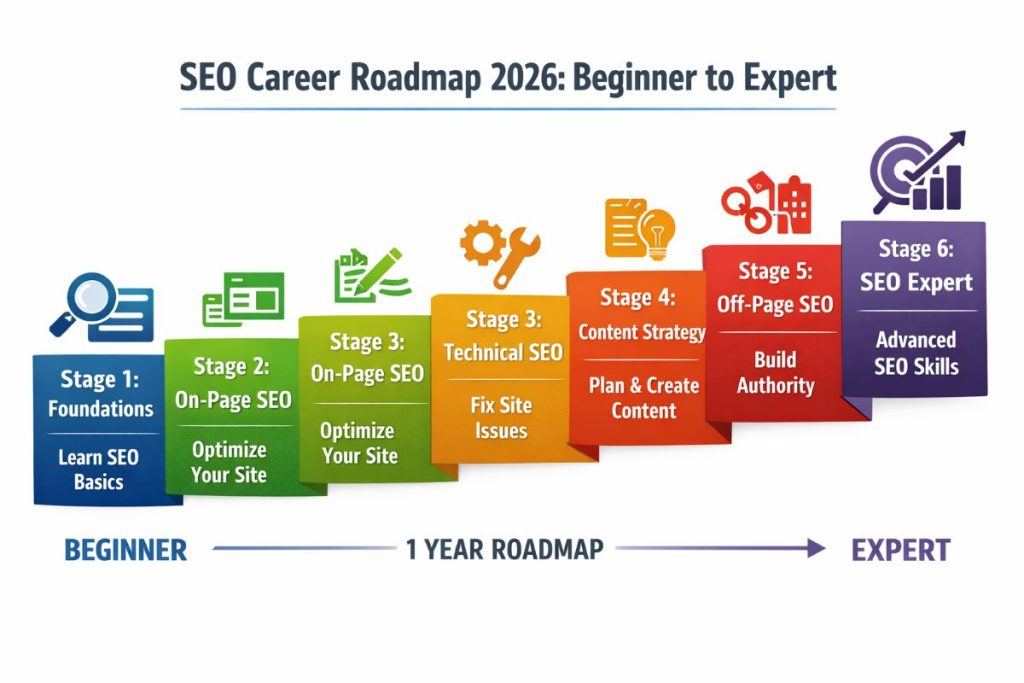
SEO Career Roadmap 2026: Beginner to Expert
Search Engine Optimization is one of the most practical digital skills you can learn in 2026. It sits at the intersection of content, marketing, analytics, and user experience, which makes it valuable across industries and countries. Whether someone is building a personal blog, running an e-commerce store, managing a startup, or working inside a large company, SEO helps them get discovered.
The challenge for beginners is not a lack of information. It is the opposite. There are too many videos, too many “secret strategies,” and too many shortcuts that sound easy but do not build real skill.
The best way to grow in SEO is to follow a clear roadmap. Learn the fundamentals, practice on real pages, measure results, and improve based on data. This article gives you a structured path from beginner to expert level, with practical milestones, must-learn skills, and common mistakes to avoid.
Why SEO Is Still a Strong Career in 2026
SEO continues to be a strong career because search is still one of the highest-intent channels on the internet. People search when they want answers, solutions, comparisons, or products. That makes organic traffic highly valuable for businesses.
Here is why SEO remains relevant worldwide:
- Search intent is powerful: Users often search when they are ready to learn, compare, or buy.
- SEO compounds over time: A well-optimized page can bring traffic for months or years.
- Every business needs visibility: Local businesses, service companies, online stores, publishers, and SaaS brands all depend on discoverability.
- SEO supports other channels: It improves content quality, website structure, conversion flow, and even paid campaign performance.
- Remote opportunities are strong: SEO work can be done from anywhere for clients around the world.
SEO is not just “ranking pages.” A skilled SEO professional helps a business attract the right audience and turn traffic into meaningful results.
The Right Mindset Before You Start
Before tools and tactics, you need the right expectations.
1) SEO is a long-term skill
You will not become an expert after a few tutorials. SEO rewards consistency, practice, and experimentation.
2) SEO is not just technical
Some people think SEO is only code and site audits. Others think it is only content writing. In reality, it includes both. Great SEO professionals understand content, user behavior, and website performance.
3) Results take time
Some improvements show up quickly, but many changes take weeks or months to produce strong results. Patience matters.
4) Portfolio matters more than certificates
Courses can help, but employers and clients care more about what you can do:
- Can you improve rankings?
- Can you find indexing issues?
- Can you optimize pages for intent?
- Can you explain results clearly?
A small portfolio with real examples is far more powerful than a long list of certificates.
The SEO Career Roadmap 2026 (Beginner to Expert)
Below is a practical roadmap divided into stages. You can follow it over 12 months, then keep building toward advanced specialization.
Stage 1: Build the Foundation (Months 1–2)
This stage is about understanding how search works. Do not rush into advanced tools yet.
1. Learn How Search Engines Work
Start with the basics:
- Crawling: How search engines discover pages
- Indexing: How pages are stored and processed
- Ranking: How search engines decide which pages appear first
- SERP features: Featured snippets, local packs, FAQs, videos, image results
When you understand these concepts, SEO stops feeling random. You begin to see why pages rank, why pages disappear, and why some content never gets indexed.
2. Understand Search Intent
This is one of the most important SEO skills.
A page ranks well when it matches what the user actually wants. That is search intent.
Main intent types
- Informational: The user wants to learn something
Example: “what is technical SEO” - Navigational: The user wants a specific website or brand
Example: “Google Search Console login” - Commercial investigation: The user is comparing options
Example: “best SEO tools for small business” - Transactional: The user wants to take action or buy
Example: “hire SEO consultant”
A simple beginner exercise
Search any keyword and review the top 10 results:
- Are they blog posts, product pages, service pages, or videos?
- Are the results beginner-friendly or advanced?
- Do they answer quickly or go deep?
This teaches you how to align content with real demand.
3. Learn Basic Keyword Research
Keyword research is not about chasing the biggest number. It is about understanding language, intent, and opportunity.
Start with free methods
- Google autocomplete
- “People Also Ask”
- Related searches
- Competitor content
- Forums and community questions
- Your audience’s real questions
What to learn first
- Primary keyword
- Secondary keywords
- Long-tail keywords
- Search intent
- Topic relevance
At this stage, avoid overthinking “difficulty scores.” Learn to understand what people are searching for and how they phrase it.
4. Learn Content Structure for SEO
Good SEO content is not written for search engines alone. It is written for people first and optimized with clarity.
Core content writing principles
- Write a clear title
- Use one strong H1
- Organize with H2s and H3s
- Keep paragraphs readable
- Answer early in the article
- Use natural wording
- Add examples where helpful
- Use internal links naturally
- Avoid repeating the same phrase too often
This is where many beginners go wrong. They force keywords into every sentence. That hurts readability and makes the page weaker.
5. Learn SEO Vocabulary
You should be comfortable with these terms:
- Meta title
- Meta description
- URL slug
- Canonical tag
- Noindex
- Sitemap
- Robots.txt
- Internal link
- Anchor text
- Redirect (301)
- CTR
- Impressions
- Structured data / schema
- Crawl budget (basic awareness)
Knowing the language helps you learn faster and communicate better with clients or teams.
Stage 2: Practice On-Page SEO on a Real Website (Months 2–4)
This is where real learning begins. Theory alone is never enough.
1. Build a Practice Website
Use a simple CMS like WordPress, Webflow, or any platform you can manage easily. WordPress is still a popular choice because it is practical and widely used.
Why your own site matters
- You can test ideas safely
- You see real indexing and ranking behavior
- You build confidence
- You create portfolio examples
- You learn from mistakes without pressure
A basic site with a few pages and a blog is enough to start.
2. Learn the On-Page SEO Checklist
Apply this process to every page you publish.
On-page essentials
- Clear topic focus
- Intent-matched title
- Clean URL structure
- One H1
- Logical headings
- Helpful introduction
- Scannable content
- Internal links to related pages
- Useful external references (when relevant)
- Image alt text
- Strong conclusion or next step
The goal is not to “tick boxes.” The goal is to make each page genuinely useful and easy to understand.
3. Improve Existing Content (Not Just New Content)
A common beginner mistake is publishing constantly without improving old pages.
Strong SEO work often comes from updating:
- Titles with low CTR
- Thin content sections
- Missing internal links
- Outdated examples
- Weak FAQs
- Poor formatting
Learning how to improve a page after it has data is a valuable professional skill.
4. Learn Basic User Experience for SEO
SEO and UX are connected. If users struggle to read or navigate your page, performance suffers.
Focus on:
- Mobile-friendly layout
- Clear fonts and spacing
- Fast loading pages
- Clean navigation
- Easy-to-find important pages
- Fewer distractions
Search engines increasingly reward content that provides a good experience, not just matching keywords.
5. Learn Image SEO Basics
Images affect performance, accessibility, and sometimes rankings.
Good image practices
- Compress images before upload
- Use descriptive file names
- Add relevant alt text
- Choose proper dimensions
- Use modern formats like WebP when possible
- Avoid oversized visuals
These small improvements can make a noticeable difference.
Stage 3: Learn Technical SEO Fundamentals (Months 4–6)
You do not need to become a developer to learn technical SEO, but you do need to understand the basics well.
1. Understand Site Architecture
A good structure helps both users and search engines.
Learn these concepts
- Pages vs posts
- Categories and tags
- Hub pages and topic clusters
- Breadcrumbs
- Internal linking hierarchy
- Orphan pages (pages with no internal links)
A clean structure makes crawling easier and supports topical relevance.
2. Learn Indexing and Crawl Control
Many SEO problems are not about content quality. They are about discoverability or indexing.
Know how to diagnose:
- Why a page is not indexed
- Whether a page is blocked by robots.txt
- Whether a page has a no-index tag
- Canonical conflicts
- Duplicate versions of the same page
- Soft 404 issues
3. Get Comfortable with Core Tools
You should learn to use these tools confidently:
- Google Search Console (must-have)
- Google Analytics / GA4 (basic traffic understanding)
- A crawling tool (such as Screaming Frog or alternatives)
- Page performance tools (like Page Speed Insights)
What to do with them
- Check indexing status
- Inspect URLs
- Review clicks and impressions
- Find crawl errors
- Identify duplicate metadata
- Spot broken links
4. Learn Common Technical Fixes (Beginner to Intermediate)
You do not need to code every fix yourself, but you should understand the issue and solution.
Learn how to handle:
- 404 pages and broken links
- 301 redirects
- Duplicate titles and descriptions
- Missing or duplicate H1s
- Canonical setup basics
- XML sitemap submission
- HTTPS and mixed-content issues
- Basic structured data implementation
The more clearly you can identify problems, the more valuable you become.
5. Learn Page Speed and Core Web Vitals (Practical Level)
Site speed matters, especially on mobile. But do not obsess over perfect scores. Focus on practical improvements.
Priorities
- Heavy images
- Too many plugins or scripts
- Unused code
- Slow hosting
- Render-blocking resources
A faster site improves user experience, which supports SEO performance over time.
Stage 4: Build SEO Content Strategy Skills (Months 6–9)
At this point, you should move beyond individual page optimization and start thinking like a strategist.
1. Learn Topic Clusters and Topical Authority
Publishing random articles rarely builds strong organic growth. Search engines respond better when your content is organized around clear topics.
Example of a topic cluster
Main topic: Email marketing
Supporting pages:
- Email marketing basics
- How to build a list
- Welcome email examples
- Email subject line tips
- Email automation guide
- Email marketing metrics
This structure helps users navigate and signals depth on the topic.
2. Learn Content Planning
A professional SEO can create a content plan, not just write pages one by one.
A good content plan includes
- Target topic or keyword
- Search intent
- Content type (guide, comparison, service page, product page)
- Priority level
- Internal linking targets
- Update schedule
This is one of the easiest ways to stand out when applying for jobs or freelance work.
3. Use Google Search Console for Optimization Opportunities
Search Console is one of the best free SEO tools in the world, and many beginners underuse it.
Learn to find:
- Pages with high impressions but low CTR
- Pages ranking on page 2
- Queries a page is already getting shown for
- Pages that dropped in clicks
- Index coverage issues
Why this matters
You can often improve traffic faster by optimizing existing pages than by publishing new ones.
4. Learn Competitor Analysis (Without Copying)
Competitor analysis is about understanding what works in your market and where gaps exist.
What to review
- Content depth and structure
- Search intent alignment
- Internal linking
- Topic coverage
- Title and meta strategy
- Content freshness
- Page format (guide, list, comparison, template)
Then ask: How can I create something more useful, clearer, or more complete?
That is the mindset of a strong SEO content strategist.
Stage 5: Learn Off-Page SEO and Authority Building (Months 9–12)
Off-page SEO helps strengthen trust and authority, especially in competitive niches.
1. Understand Backlinks Properly
Backlinks still matter, but quality matters more than volume.
Strong backlinks usually have:
- Relevant context
- Natural placement in content
- Real websites with real audiences
- Diverse anchor text
- Editorial value
Avoid:
- Spammy link packages
- Automated link schemes
- Irrelevant directories
- Over-optimized anchor text
A good rule: If a link only exists to manipulate rankings and offers no user value, it is risky.
2. Learn Safer Link Building Methods
You do not need advanced outreach from day one. Start with practical methods.
Beginner-friendly approaches
- Guest posting on relevant sites
- Linkable assets (guides, templates, original resources)
- Outreach for broken link replacements
- Resource page inclusion
- Partnerships and collaborations
- Local citations (for local businesses)
The key is to focus on value and relevance, not shortcuts.
3. Learn Brand and Trust Signals
SEO in 2026 is not only about keywords and links. Trust matters more than ever.
Improve trust with:
- Clear author pages
- Detailed About page
- Contact information
- Editorial standards (for content-heavy sites)
- Testimonials and case studies
- Consistent branding
- Updated content
These signals help users trust your website, and they often improve performance indirectly.
4. Learn Local SEO Basics (Even if You Plan to Work Globally)
Local SEO is a great skill because many businesses need it, and results can be more visible.
Learn the basics:
- Google Business Profile optimization
- NAP consistency (name, address, phone)
- Local landing pages
- Review generation strategy
- Local citations
- Location-based keyword targeting
Even if you want to work globally, local SEO is a strong entry point for paid client work.
Stage 6: Grow Into an Expert SEO Professional (Year 2 and Beyond)
Expert-level SEO is not about knowing every trick. It is about making smart decisions, prioritizing work, and driving business results.
1. Learn to Perform Professional SEO Audits
An expert audit is not just a list of problems. It is a roadmap.
A strong audit includes:
- Executive summary
- Priority levels (high, medium, low)
- Business impact
- Technical findings
- Content findings
- Internal linking opportunities
- Quick wins
- Long-term recommendations
Example of expert thinking
Instead of saying:
“Many pages have weak internal links.”
Say:
“Key commercial pages are not receiving enough internal link equity from high-traffic blog content, which may limit visibility for high-conversion queries. Add contextual links from top-performing informational pages.”
That level of clarity makes your work more valuable.
2. Learn SEO by Business Model
SEO strategy changes depending on the type of website.
Learn how SEO differs for:
- Blogs and publishers
- Service businesses
- E-commerce stores
- SaaS products
- Affiliate websites
- Local businesses
- Enterprise websites
If you specialize in one area, your market value can rise quickly.
3. Learn Analytics and Reporting for Decision-Making
At the expert level, you need to connect SEO work to outcomes.
Important metrics to track
- Organic clicks and impressions
- CTR
- Keyword visibility (with context)
- Landing page performance
- Conversions or leads
- Revenue impact (when available)
Reporting skill matters
Clients and managers do not just want data. They want clarity:
- What changed?
- Why did it change?
- What should we do next?
The ability to explain results simply is a major career advantage.
4. Learn Smart AI-Assisted SEO Workflows
AI tools can speed up research and drafting, but they should not replace critical thinking.
Good uses of AI in SEO
- Content outlines
- Title and headline ideas
- Meta description drafts
- FAQ ideas
- Content gap brainstorming
- Brief creation
- Rewrite suggestions for clarity
What still needs human judgment
- Search intent analysis
- Fact-checking
- Brand voice
- Original insights
- Final editing
- Strategy decisions
The best SEO professionals use AI as a productivity layer, not as a shortcut to publish low-quality content.
5. Build Communication and Client Skills
Technical ability gets you noticed. Communication gets you retained.
Learn to:
- Explain SEO in plain language
- Set realistic expectations
- Prioritize tasks by impact
- Collaborate with writers and developers
- Present monthly progress clearly
- Handle ranking volatility calmly
Many skilled people struggle professionally because they cannot explain their work. Strong communication is a career multiplier.
Recommended SEO Skill Stack (Global)
To become well-rounded, build this stack over time.
Core SEO Skills
- Search intent analysis
- Keyword research
- On-page optimization
- Technical SEO fundamentals
- Internal linking
- Content optimization
- Search Console usage
Supporting Skills
- CMS management (WordPress or similar)
- Basic HTML/CSS understanding
- Analytics (GA4)
- Reporting tools
- Content writing and editing
- UX basics
- Image optimization
High-Value Advanced Skills
- Conversion rate optimization (CRO)
- E-commerce SEO
- International SEO
- JavaScript SEO (advanced)
- Structured data strategy
- Programmatic SEO (advanced)
- Automation workflows
You do not need all of these at once. Build step by step.
A Simple 12-Month SEO Learning Plan
Here is a practical timeline you can follow.
Months 1–2: Foundations
- Learn how search works
- Understand search intent
- Practice basic keyword research
- Study SEO-friendly content structure
Months 3–4: On-Page Practice
- Build a practice website
- Publish and optimize pages
- Learn internal linking
- Improve page readability and UX
Months 5–6: Technical Basics
- Learn Search Console
- Diagnose indexing issues
- Practice crawls
- Fix common technical issues
- Improve site speed basics
Months 7–8: Content Strategy
- Build topic clusters
- Create a content plan
- Optimize existing content
- Learn competitor analysis
Months 9–10: Off-Page and Authority
- Study backlink quality
- Practice outreach basics
- Learn trust-building site elements
- Explore local SEO fundamentals
Months 11–12: Portfolio and Professional Skills
- Create SEO audit samples
- Build reports from real data
- Document case studies
- Apply for jobs or freelance projects
This timeline is flexible. Some people move faster, some slower. What matters is consistent practice.
How to Build an SEO Portfolio Without a Job
You do not need to wait for a paid role to prove your skills.
1) Build your own website
This is the best training ground and the best proof of work.
Show:
- Optimized pages
- Content strategy examples
- Search Console screenshots (if relevant)
- Before/after improvements
- Technical fixes
2) Help a small project
Offer help to a local business, friend, nonprofit, or community project. Even one small success can become a strong case study.
3) Create sample audits
Pick a website (with care and respect) and create a short audit:
- Technical issues
- On-page improvements
- Content opportunities
- Priority recommendations
This shows structured thinking.
4) Document your process
Do not just show results. Show how you worked:
- What problem did you identify?
- What did you change?
- What happened afterward?
This makes your portfolio much more convincing.
Common Mistakes Beginners Should Avoid
1) Keyword stuffing
Repeating the same phrase over and over weakens the content and makes it harder to read.
2) Chasing only high-volume keywords
Big keywords are often too broad or too competitive. Start with clear, specific topics.
3) Ignoring search intent
If your page format does not match what users want, rankings are difficult to sustain.
4) Publishing without internal links
Even great pages can underperform if they are isolated.
5) Neglecting Search Console
It is free and incredibly useful. Learn it early.
6) Expecting instant results
SEO growth is often uneven. Some pages jump, drop, and recover. Focus on long-term patterns.
7) Copying competitors too closely
Use competitor research for direction, not duplication. Your page should add value, not imitate.
Career Paths After Learning SEO
SEO can lead to multiple career directions.
1) Freelance SEO Specialist
Work with clients on audits, on-page optimization, content strategy, or local SEO.
2) In-House SEO Executive or Specialist
Join a company and focus on growing one brand over time.
3) SEO Content Strategist
Plan content systems, not just individual articles.
4) Technical SEO Specialist
Focus on crawling, indexing, site architecture, and performance.
5) Local SEO Consultant
Help local businesses improve search visibility and lead generation.
6) SEO + Web Design / Development Hybrid
A very strong combination for freelance and agency work.
7) Build Your Own Organic Business
Use SEO to grow your own blog, affiliate site, niche media site, or digital product business.
conclusion
SEO is one of the few skills where a beginner can start with low cost, build real experience quickly, and grow into a high-value professional role over time. It is not a shortcut career, but it is a strong one.
If you follow a structured path—learn the fundamentals, practice on a real site, measure performance, and improve based on data—you will build skills that remain useful across industries and markets.
The best part is that SEO rewards people who stay curious. Search behavior changes. Technology changes. Content standards evolve. If you keep learning and keep testing, your value grows year after year.
FAQ
1) How long does it take to learn SEO?
Most beginners can learn the basics in 2–3 months with regular practice. Becoming job-ready usually takes 6–12 months, depending on how much hands-on work you do.
2) Do I need coding skills to become an SEO expert?
No, but basic HTML and CSS knowledge is very helpful. You do not need to be a developer, but understanding how websites work gives you an advantage.
3) Is SEO a good freelance career in 2026?
Yes. Businesses worldwide still need organic traffic, and many prefer hiring freelancers or consultants for audits, optimization, and ongoing strategy.
4) What should I learn first: content SEO or technical SEO?
Start with fundamentals, search intent, and content optimization. Then learn technical SEO basics. Both matter, but content and intent are easier entry points for beginners.
5) Which tool is most important for beginners?
Google Search Console is the most important free tool to learn early. It helps you understand indexing, impressions, clicks, and page performance.
6) Can I get SEO clients without agency experience?
Yes. A strong portfolio, your own website, and a few small case studies can be enough to get your first clients.
7) Is AI replacing SEO jobs?
AI is changing workflows, but it is not replacing strategic SEO work. Businesses still need people who can analyze intent, improve content quality, solve technical issues, and connect SEO to results.
8) What is the biggest mistake new SEO learners make?
Focusing only on tricks instead of fundamentals. Long-term success comes from understanding users, improving websites, and making data-based decisions.