
Table of Contents
ToggleSearch Engine Algorithms: What SEOs Must Know
FAQ
1) Do backlinks still matter in 2026?
Yes, but quality matters more than quantity. A small number of relevant, editorial links can outperform hundreds of weak links.
2) How often do algorithms change?
Small changes happen daily. Larger updates happen regularly. That’s why you should build SEO based on fundamentals, not tricks.
3) Can I rank without writing long articles?
Yes. You can rank with shorter pages if you satisfy intent better than competitors. Depth is more important than word count.
4) What’s the biggest reason good content doesn’t rank?
Usually technical/indexing issues or weak internal linking. Sometimes it’s because the content is too similar to what already ranks.
5) Is keyword density still important?
Not in the old way. Use the main keyword naturally in critical places (title, intro, a heading, URL if appropriate), then write for humans using related language.
Search Engine Algorithms: What SEOs Must Know
Search engines don’t “read” websites the way humans do. They use algorithms—systems made of many signals and models—to decide which pages deserve to rank, where, and why.
If you’re doing SEO in 2026, the goal isn’t to “trick” an algorithm. The goal is to align your content and site experience with what the algorithm is trying to reward: relevance, trust, and satisfying user intent.
This guide breaks down how search algorithms really work in practice, what matters most today, and how to build SEO that survives updates—using clear examples and a helpful FAQ.
1) What “Search Algorithm” Actually Means
A search algorithm is not one single formula. It’s a pipeline:
- Crawling – discovering pages
- Indexing – understanding and storing pages
- Ranking – ordering results for a query
- Serving – showing the best result in the best format (web results, snippets, local pack, videos, etc.)
Each step has its own rules and failure points. Many SEO problems aren’t “ranking” problems at all—they’re crawling or indexing problems.
Example: The Invisible Page Problem
You publish a great article. Your page is:
- blocked by robots.txt, or
- set to “no-index,” or
- canonicalized to a different URL, or
- too deep in site structure (no internal links)
Result? Google can’t index it properly, so it won’t rank—even if the content is excellent.
SEO lesson: Ranking starts with access and clarity, not writing alone.
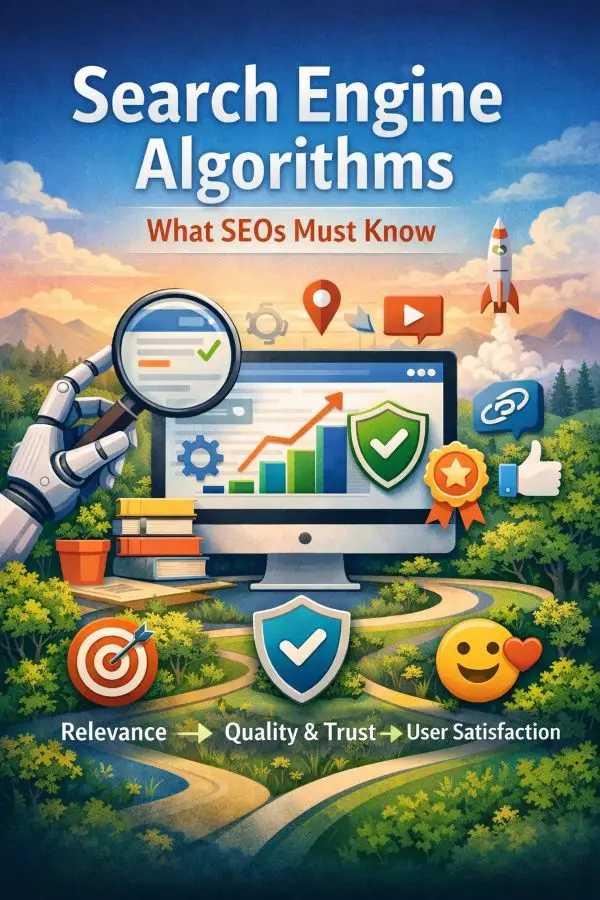
2) The Three Core Goals of Search Engines
Most algorithm updates make sense when you remember what search engines want:
A) Relevance
Does the page match what the user means?
B) Quality & Trust
Is the information reliable? Is the site credible? Is the content original and helpful?
C) User Satisfaction
Do searchers feel happy after clicking the result—or do they bounce back to Google?
Search engines measure satisfaction indirectly through patterns (like repeated searches, quick returns, diverse signals, and content usefulness models). They don’t just count keywords.
3) How Ranking Works: The Modern SEO Model
Think of ranking like a multi-layer filter:
Layer 1: Basic Eligibility
- Crawlable
- Indexable
- Not spammy
- Not a duplicate of something else
- Loads reasonably and works on mobile
Layer 2: Query Understanding
Search engines interpret:
- synonyms and context
- location (local intent)
- freshness needs
- intent type: informational, commercial, transactional, navigational
Layer 3: Document Understanding
The algorithm tries to understand:
- main topic (what is this page about?)
- depth and coverage
- uniqueness vs. generic rewriting
- structure (headings, sections, lists, media)
- entities and relationships (people, brands, places, products)
Layer 4: Authority & Trust Signals
- strong backlinks (quality > quantity)
- brand mentions and reputation
- author/site track record
- consistent helpful content over time
Layer 5: Experience & Satisfaction
- speed, UX, ad experience
- content clarity and readability
- whether users find it helpful
Important: In 2026, SEO success is more about content usefulness + trust + technical clarity than repeating a keyword 25 times.
4) Crawling: The Part Most People Ignore Until It Hurts
Crawling is how search engines discover and revisit pages. If your crawl budget gets wasted, important pages can be delayed or missed.
What affects crawling?
- Internal linking structure
- Sitemap accuracy
- server speed and stability
- too many low-value pages (tags, filters, duplicate URLs)
- redirect chains and 404s
Example: E-commerce Category Chaos
You have:
- /shoes?color=black
- /shoes?color=black&size=42
- /shoes?sort=price-low
Thousands of variations → crawling gets messy → core pages crawl less often.
Fix:
- canonicalize clean URLs
- no-index thin filter pages where needed
- strong internal links to priority pages
5) Indexing: How Search Engines Decide What to Store
Indexing isn’t automatic. Google might crawl but still decide:
- not to index
- to index a different version (canonical)
- to treat a page as duplicate
- to delay indexing due to low perceived value
Common indexing killers
- thin or “same as everyone” content
- auto-generated text with little original value
- too many similar pages
- weak internal links (or none)
Example: “Discovered – currently not indexed”
This often happens when:
- the site has many similar pages
- the content doesn’t stand out
- internal links are weak
- the site is new and not trusted yet
Fix approach:
- improve content uniqueness
- add internal links from strong pages
- reduce duplication
- ensure correct canonical tags
- publish supporting content clusters (see section 9)
6) Ranking Signals SEOs Must Understand
Search engines use hundreds of signals, but you can focus on the “big levers.”
1) Intent match
Your content must match the reason someone searched.
Example query: “best laptop for SEO work”
User intent: comparisons, budgets, specs, recommendations.
A page that defines “SEO” won’t rank.
2) Topical depth (not length)
Longer isn’t always better. Better is better.
Depth means:
- covers the main subtopics users expect
- answers common questions
- provides real examples
- explains decisions and trade-offs
3) Uniqueness and value-add
If your article sounds like 50 other articles, you’re competing with the best-established version of the same content.
Value-add ideas:
- your own workflow
- templates
- checklists
- local context (e.g., Nepal market examples)
- case studies (even small ones)
4) Trust signals
Especially for topics that affect money, health, safety, or big decisions, search engines are stricter.
Trust signals include:
- clear author and contact info
- genuine about page
- sources and references when needed
- transparency (who runs the site, why it exists)
5) Backlinks and authority
Backlinks still matter, but the algorithm cares about:
- relevance of linking site
- editorial nature (not spam)
- natural anchor usage
- consistency
A few good links can beat hundreds of weak ones.
6) Page experience & usability
If your page is slow, messy, pop-up heavy, or confusing—users won’t stay.
SEO isn’t only “ranking.” It’s earning the click and keeping it.
7) The Real Meaning of “Algorithm Updates”
Algorithm updates are usually not “punishments.” They’re rebalancing what gets rewarded.
Common update themes:
- reducing low-value content
- improving detection of spam
- boosting helpful, original pages
- improving understanding of intent and entities
- refining quality and trust evaluation
How to respond to an update (the right way)
- Identify which pages dropped (type, intent, topic)
- Compare with pages now ranking
- Look for patterns: content depth, format, trust signals, UX
- Improve pages with the biggest business value first
- Keep changes meaningful (not random edits)
Avoid: panic rewriting everything, changing URLs, or keyword stuffing.
8) Keyword Stuffing Is Dead. Here’s What Works Instead.
Keyword stuffing used to work because old algorithms matched strings. Modern algorithms understand meaning.
What to do instead
Use a “topic-first” outline
Start with:
- what the reader wants
- what they need next
- what would make this page the best answer
Then naturally include:
- the primary term
- synonyms and related terms
- entities (tools, concepts, brands, steps)
Write like you explain to a friend
If a sentence sounds unnatural, Google will likely treat it as low quality too.
Bad (stuffed):
“Search engine algorithms are important for SEOs because search engine algorithms change and SEOs must know search engine algorithms.”
Good (human):
“Search algorithms change constantly, but the foundations don’t. If you focus on satisfying intent, building trust, and keeping your site technically clean, most updates won’t hurt you.”
9) Content Strategy That Aligns With Algorithms: Topic Clusters
A powerful modern approach is building clusters:
- Pillar page: broad, high-value topic
- Supporting pages: deep subtopics that link back to the pillar
Example cluster: “SEO for Small Businesses”
Pillar: “SEO for Small Businesses: A Practical Guide”
Supporting:
- “Local SEO checklist”
- “How to choose keywords for service pages”
- “How to write SEO-friendly content”
- “Technical SEO basics for WordPress”
- “How to earn backlinks without spam”
This structure helps algorithms understand:
- your site’s expertise in a topic
- relationships between pages
- which page is the best canonical resource
10) Practical On-Page SEO That Algorithms Actually Reward
Titles that earn clicks (and rankings)
Good titles are:
- clear
- specific
- aligned with intent
- not clickbait
Example:
Instead of: “Search Engine Algorithms Explained”
Use: “Search Engine Algorithms: How Rankings Work + SEO Checklist (2026)”
Headings that guide the reader
Use H2/H3 to structure the page like a mini course:
- definitions
- steps
- examples
- mistakes
- FAQ
Internal links that build understanding
Link from:
- strong pages → new pages
- related pages → each other
- pillar ↔ supporting pages
Use descriptive anchors:
- “technical SEO checklist”
- “how to fix no-index and canonical issues”
Snippet-friendly formatting
If you want featured snippets:
- define terms in 1–2 sentences
- include short lists (steps, bullets)
- answer questions clearly in headers
11) Off-Page SEO: Reputation Is the New Link Building
In 2026, off-page is not just backlinks. It’s reputation.
Ways to build it safely:
- guest posts on real industry sites
- digital PR (data, insights, unique stories)
- partnerships (local businesses, communities)
- showcasing real results and case studies
- being cited as a source
Avoid:
- paid link networks
- spammy directories
- automated outreach blasts
- “SEO packages” that promise 1,000 links
12) A Simple SEO Checklist for Algorithm-Proof Growth
Use this as your “safe SEO” baseline:
Technical
- ✅ HTTPS, mobile-friendly, fast pages
- ✅ clean index (no duplicate chaos)
- ✅ correct canonicals
- ✅ XML sitemap updated
- ✅ internal linking supports important pages
- ✅ no broken links / redirect chains
Content
- ✅ matches intent
- ✅ covers key subtopics readers expect
- ✅ original value-add (examples, workflow, insights)
- ✅ clear structure (H2/H3, lists, tables)
- ✅ updated when needed
Trust
- ✅ author/about/contact pages
- ✅ transparent business info
- ✅ references for factual claims
- ✅ reviews / mentions where relevant
Authority
- ✅ a few high-quality backlinks
- ✅ brand building (social, community, collaborations)
- ✅ consistent publishing in a niche
conclusion
Search engine algorithms will keep evolving, but the winning SEO approach stays surprisingly stable: make your site easy to crawl and index, match search intent better than anyone else, and build real trust over time. Instead of chasing every update or forcing keywords into every line, focus on creating pages that genuinely solve the user’s problem—clearly, quickly, and with helpful examples.
If you consistently publish original, well-structured content, support it with strong internal linking, keep your site technically clean, and earn relevant authority signals (quality links and brand mentions), you’ll build rankings that last—even when the algorithm changes.