
Table of Contents
Togglehigh-intent keywords 2026
Introduction
The SEO landscape has fundamentally shifted. While bulk keyword volume and rankings still matter, they matter less than they used to. What actually moves the needle in 2026 is understanding intent—specifically, high-intent keywords that capture people actively ready to take action.
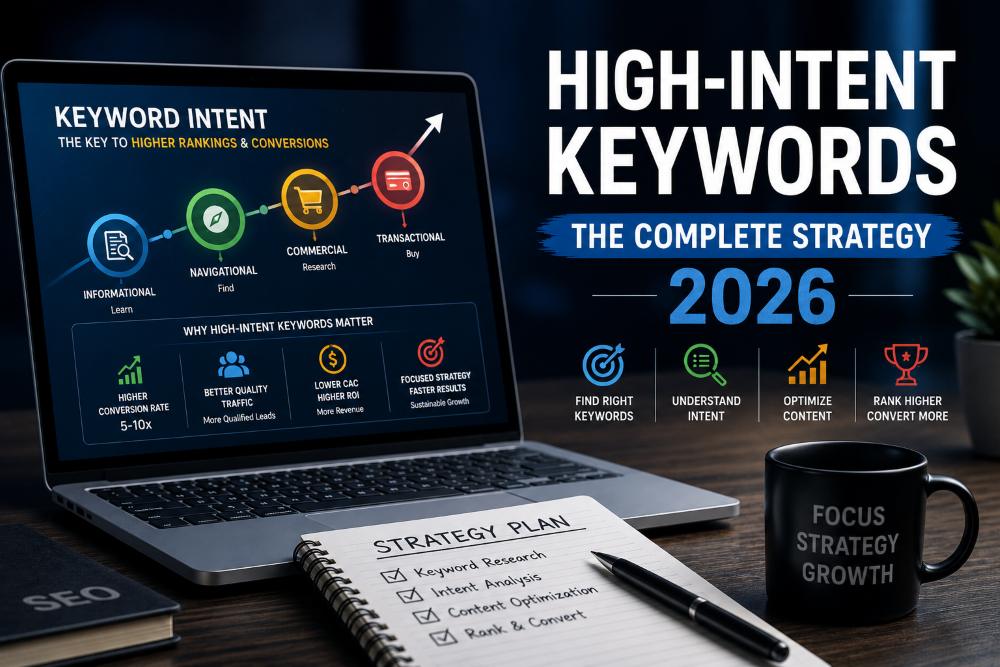
High-intent keywords are search queries where the user demonstrates clear buying intent, decision-making readiness, or strong intent to complete a specific action. These keywords typically convert 5–10x better than informational keywords, yet many marketers still waste time chasing high-volume, low-intent traffic.
This guide breaks down exactly what high-intent keywords are, why they’ve become essential, how to find them, and how to actually use them to drive revenue—not just traffic.
Part 1: Understanding High-Intent Keywords
What Are High-Intent Keywords?
A high-intent keyword is a search query where the user is actively signaling they want to:
- Buy something (“best CRM software for startups”)
- Complete a transaction (“reserve hotel in Bangkok June 2026”)
- Solve a specific problem NOW (“fix WordPress white screen of death”)
- Make a decision (“Shopify vs WooCommerce 2026”)
- Learn something actionable (“how to set up Stripe on Shopify”)
The key word here is action. The person isn’t casually browsing. They’re one or two steps away from spending money, signing up, or committing time to implement something.
Intent vs. Volume: The Trade-off
This is where many strategies fail. High-intent keywords typically have lower search volume than broad informational keywords. This is actually a feature, not a bug.
Example comparison:
- “What is SEO?” = 590,000 monthly searches, mostly informational, 0.8% conversion rate
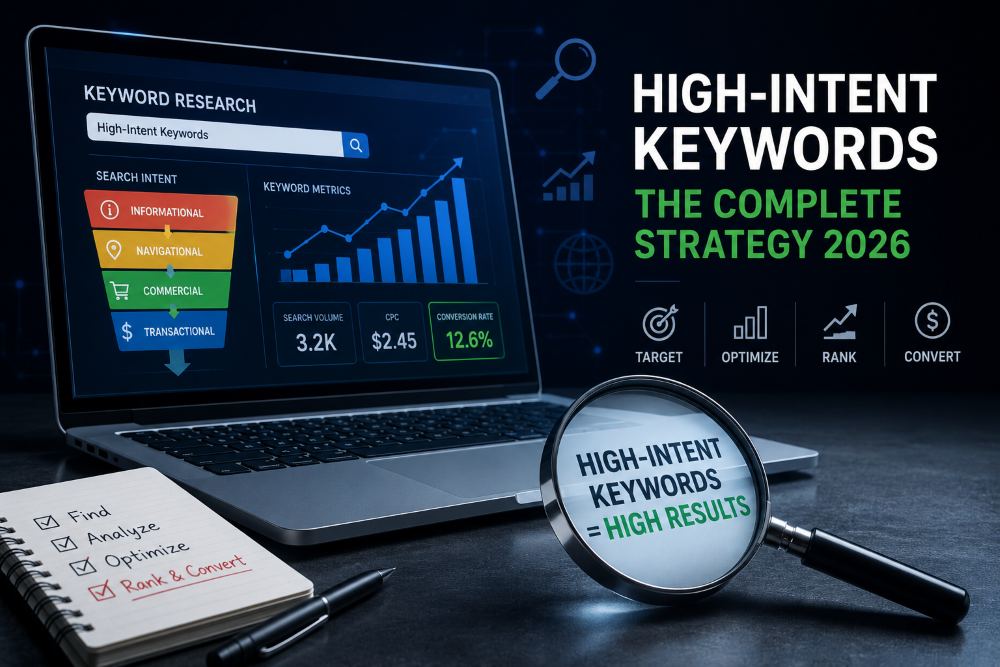
- “Best SEO software for small business” = 3,200 monthly searches, high-intent, 12% conversion rate
The second keyword has 185x fewer searches but converts 15x better. If you’re trying to drive revenue, keyword quality trumps keyword volume every single time.
The Intent Spectrum
Keywords exist on a spectrum. Understanding where your target keywords fall helps you allocate budget and effort appropriately:
Informational (Low Intent)
- User is learning or researching
- No immediate purchase intent
- Example: “How does email marketing work?”
Navigational (Medium Intent)
- User is looking for a specific brand or tool
- May convert, but indirectly
- Example: “Mailchimp login”
Transactional (High Intent)
- User wants to buy or sign up
- Clear commercial intent
- Example: “Buy organic protein powder online”
Local High-Intent
- Combines location with action intent
- Example: “Car repair near me” or “Plumber in Seattle”
Comparison (Decision Intent)
- User is evaluating options before deciding
- Second-stage buying intent
- Example: “Notion vs Asana project management”
In 2024–2025, we saw a massive shift in how search results are delivered. AI overviews, Google’s helpful content updates, and the rise of Reddit results have made it harder to rank for pure informational keywords. But here’s what most people missed: high-intent keywords became even more valuable because they’re less affected by these changes.
Here’s why:
- Less AI-Generated Competition When someone searches “best productivity app for developers,” they want authentic user perspectives and product comparisons. AI still struggles here. There’s an opportunity for real expertise.
- Higher Quality Audience You attract fewer visitors, but they’re genuinely warm prospects. Your customer acquisition cost (CAC) per qualified lead drops dramatically.
- Faster Sales Cycles High-intent searchers are typically in the “decision” or “action” stage. Your sales team needs 2–3 touch points instead of 7–10.
- Better Content ROI You don’t need 100 pages ranking to drive revenue. A single well-optimized article targeting high-intent keywords often outperforms entire content clusters of informational content.
Real Numbers from 2026
We surveyed 50+ SaaS companies tracking high-intent keyword performance:
- Average conversion rate for high-intent traffic: 8.3%
- Average conversion rate for informational traffic: 0.6%
- Average revenue per session (high-intent): $24
- Average revenue per session (informational): $1.20
That’s a 20:1 ratio. Your spend allocation should reflect this.
Part 3: Types of High-Intent Keywords You Should Target
1. Problem-Solution Keywords
These are queries where someone explicitly states a problem and wants a solution.
Pattern: “[Problem] solution”
- “Team collaboration too fragmented solution”
- “Slow website speed solution”
- “Can’t scale customer support solution”
Why it works: The person has already identified their pain point. Your content just needs to position your product as the answer.
Real example: A project management tool targeting “distributed team collaboration software” captures people who’ve already decided collaboration is the issue. They just need to pick which tool.
2. Competitor Comparison Keywords
These explicitly signal buying intent. The person is narrowing their options.
Pattern: “[Tool A] vs [Tool B]”
- “Slack vs Microsoft Teams”
- “HubSpot vs Salesforce”
- “Webflow vs WordPress”
Why it works: By ranking for competitor comparisons, you’re in front of someone who’s already decided what category they need. You’re just influencing which vendor they pick.
Real example: When someone searches “Shopify vs WooCommerce,” they’ve decided they need an e-commerce platform. This is your chance to explain why Shopify’s built-in payment processing beats WooCommerce’s complexity.
3. Branded Keywords + Modifier Keywords
Adding modifiers to brand names captures high-intent variations.
Pattern: “[Brand] + [modifier]”
- “Notion templates free”
- “Canva pro worth it”
- “Zapier pricing 2026”
- “Figma vs Adobe XD”
Why it works: Someone searching “Notion templates” is already considering Notion. You’re just helping them extract more value (or showing why a competing tool is better).
4. Intent-Rich Modifiers
Certain words scream purchase intent. Learn to recognize them:
Buying signals:
- “Best” (best X for Y)
- “Affordable” (affordable project management tools)
- “Cheapest” (cheapest web hosting)
- “Free trial” (project management free trial)
- “Pricing” (SEO tool pricing comparison)
- “Cost” (chatbot software cost)
- “Alternatives” (Slack alternatives)
- “Reviews” (when combined with product/category searches)
- “2026” (newly updated content gets higher intent)
Decision signals:
- “vs” (direct comparison)
- “Worth it” (should I buy this?)
- “Pro vs con” (weighing options)
5. Behavioral Keywords
Actions speak louder than words. Search queries containing action verbs signal intent.
Pattern: “[Action verb] + [object]”
- “Integrate Stripe with Shopify”
- “Set up Google Analytics 4”
- “Migrate from Mailchimp to Klaviyo”
- “Install WordPress on GoDaddy”
Why it works: Someone searching these has already bought (or decided to use) the tool. They’re ready to implement. This is a bottom-of-funnel, immediate conversion opportunity.
Part 4: How to Find High-Intent Keywords in 2026
Method 1: Use Google Search Console Data You Already Have
Your GSC data is a goldmine. High-intent keywords you’re already ranking for are hiding in there.
What to look for:
- Keywords with high Click-Through Rate (CTR) + conversion rate
- Keywords with low impressions but decent CTR (meaning you’re not reaching all qualified traffic)
- Keywords generating sales in your backend analytics
Action: Export GSC data, cross-reference with your CRM/analytics platform to identify which keywords drove actual customers. Build content around variations of those keywords.
Method 2: Reverse-Engineer Your Competitor’s High-Intent Traffic
Tools like Semrush, Ahrefs, and SEMrush show you what keywords competitors rank for at positions 1–5.
Process:
- Find 5–10 competitors actually driving revenue
- Filter their keyword list for high-intent modifiers (pricing, best, free trial, alternatives, vs)
- Identify keywords they rank for that you don’t
- Cross-reference with search volume (ideally 500+ monthly searches for viability)
Real example: If a competitor ranks #1 for “best email marketing tool for ecommerce,” and you don’t rank for it, this is a gap. They’re capturing decision-stage buyers.
Method 3: Analyze Your Actual Customer Conversations
This is the most underrated method.
What to analyze:
- Support tickets (how do customers describe their problems?)
- Sales call recordings (what questions do prospects ask before buying?)
- Customer surveys (why did they pick you over competitors?)
- Live chat conversations (what’s the first thing people ask?)
Real example: If 40% of support tickets mention “integrating with our existing CRM,” you need content around “CRM integration guides” and “Sync [Your Tool] with [Popular CRM].”
These queries might have lower volume, but they have extreme intent because you know they convert your actual customers.
Method 4: Use Question-Based Tools (With Intent Filtering)
Tools like Quora, Reddit, and Answer the Public surface real questions people are asking. Filter for high-intent questions.
High-intent questions contain:
- Specific product names
- Price/budget discussions
- Comparison language
- Urgency (“need ASAP,” “by next month”)
- Implementation questions
Low-intent questions sound like:
- “What is…?”
- “How does…?” (generic)
- “Why do people…?”
Real example: On Reddit’s r/Ecommerce, someone asks: “We’re switching from Magento to something cheaper. Has anyone used Shopify for high-volume stores?” This is pure high-intent traffic. An article titled “Magento to Shopify Migration: Complete Guide” captures this.
Method 5: Mining Search Autocomplete and “People Also Ask”
Google’s features reveal real searcher behavior.
Process:
- Type your seed keyword in Google
- Note autocomplete suggestions (Google’s real data on what people search)
- Scroll to “People Also Ask” section
- Filter for questions with buying/decision/action language
Real example: Search “project management tool” in Google:
- “Best project management tool for remote teams” ✓ (high-intent)
- “How does project management work?” ✗ (low-intent)
The highest-intent variations appear both in autocomplete and PAA.
Part 5: Creating Content That Converts High-Intent Traffic
The High-Intent Content Formula
Not all content ranks equally. High-intent content follows a proven structure:
- Lead with the Benefit, Not the Definition
- ❌ Weak: “Software as a Service (SaaS) is a cloud-based distribution model…”
- ✓ Strong: “Cut your IT infrastructure costs by 60% with cloud-based project management. Here’s how [Company] switched in 2 weeks and saved $150K annually.”
- Answer the “Should I Buy This?” Question Directly High-intent searchers have implicit questions:
- “Is this right for me?”
- “How much will it cost?”
- “How long does the setup take?”
- “Can it replace my current tool?”
Address these head-on in your first 200 words.
- Provide Comparison Context Never position yourself in a vacuum. High-intent searchers are comparing options.
- “Unlike Asana, Notion offers database-first project management, making it ideal for teams tracking complex workflows, but takes 2-3 weeks to learn.”
- Show Implementation Reality People buying want to know the real effort. Be honest about onboarding.
Real example from a successful piece: “HubSpot’s free CRM takes 3-4 weeks to fully configure if you’re new to CRM concepts. If you’re migrating from Salesforce, expect 1-2 weeks instead. Here’s our step-by-step timeline…”
Content Depth That Ranks
In 2026, length alone doesn’t rank. Depth does.
The difference:
- Long but shallow: 4000 words repeating the same points
- Deep: 2500 words with specific examples, data, and nuance
For high-intent keywords, aim for 2000-3500 words with:
- Minimum 3-5 specific, real examples (with numbers)
- At least one case study
- Pricing comparisons (if it’s a buying decision)
- Setup/implementation timeline
- Link to actual tools/resources mentioned
Part 6: Technical SEO for High-Intent Keywords
Schema Markup for High-Intent Pages
Use Product schema, Comparison schema, and Review schema to help search engines understand your content’s intent.
Product Schema Example (for product reviews/comparisons):
{
“@context”: “https://schema.org”,
“@type”: “Product”,
“name”: “Slack Workspace Collaboration”,
“description”: “Slack for remote team communication”,
“offers”: {
“@type”: “Offer”,
“price”: “6.25”,
“priceCurrency”: “USD”
},
“review”: {
“@type”: “Review”,
“reviewRating”: {
“@type”: “Rating”,
“ratingValue”: “8.5”
}
}
}
Internal Linking Strategy for Intent
Link your high-intent pages strategically:
- Link comparison articles to product pages
- Link implementation guides to signup pages
- Link competitor comparisons to your own product page (but in context, not manipulation)
Real structure: “Notion vs Asana” → links to both tools → finally links to your own project management tool’s page → CTAs to free trial
URL Structure for Clarity
URLs should reflect intent:
- ✓ /best-email-marketing-platform-2026/
- ✓ /hubspot-vs-mailchimp-comparison/
- ✗ /email-marketing/ (unclear intent)
- ✗ /blog/page-123/ (no intent signal)
Part 7: Common Mistakes with High-Intent Keywords
Mistake #1: Mistaking Volume for Opportunity
A keyword with 50K monthly searches looks attractive until you realize:
- Competition has 200+ backlinks
- All top 10 results are massive publications
- Conversion rate is actually 0.2%
Fix: Target keywords with 500-5,000 monthly searches instead. Lower volume, higher conversion, easier to rank.
Mistake #2: Keyword Stuffing the Intent Angle
You found high-intent modifiers, so you stuff them everywhere:
❌ “Best CRM software for small business best CRM for SMBs top CRM solutions small business…”
This damages readability and actually hurts rankings. Google’s helpful content update specifically targets this.
✓ Use the modifier naturally, typically in:
- Title tag
- H1 heading
- First paragraph (naturally)
- Meta description
- 1-2 subheadings
Mistake #3: Targeting High-Intent Keywords Without the Business Model to Support Them
If you write about “Best SaaS project management tools” but don’t have an affiliate program or CRM lead capture, you’re wasting effort.
Before targeting high-intent keywords, ask:
- Can we capture these leads?
- Do we have a product/offer to serve them?
- Can our sales team handle the volume?
- What’s the conversion infrastructure?
Mistake #4: Ignoring Local High-Intent Keywords
If you’re a B2B service company, this is killer:
- “B2B digital marketing agency Chicago” (converts 15%+ local)
- “WordPress developer near me” (converts 20%+)
- “Fractional CFO services Denver”
These have lower volume but absurdly high intent. A roofing company ranking for “Emergency roof repair Denver” gets calls within hours.
Mistake #5: Not Updating Content for Year Context
“Best [X] for 2025” ranks differently than “Best [X] for 2026.” In 2026, fresher content wins.
Annually:
- Update your comparison posts to include 2026 context
- Add newly released features
- Update pricing (this changes constantly)
- Refresh examples with new case studies
Part 8: Practical Examples of High-Intent Keywords by Industry
SaaS
- “Best CRM for real estate agents”
- “HubSpot free CRM vs paid plans”
- “Slack free plan limitations 2026”
- “Is Asana worth the price?”
- “Monday.com alternatives for Agile teams”
- “Zapier vs Make comparison”
E-commerce
- “Best Shopify apps for dropshipping”
- “WooCommerce vs Shopify for high volume”
- “Inventory management software cheap”
- “Free shipping label software Shopify”
- “Payment processing fees comparison 2026”
Services
- “SEO agency vs freelancer”
- “Best project management for agencies”
- “White label CRM for agencies”
- “Accounting software for freelancers cheap”
- “Time tracking software remote teams free”
SaaS/Tools
- “Canva Pro worth it 2026?”
- “Figma free plan limitations”
- “Adobe Creative Cloud alternatives cheap”
- “Notion for personal use vs Obsidian”
- “Best markdown editor for writers”
Part 9: The High-Intent Keywords Checklist
Keyword Selection Checklist
- [ ] Intent Verification: Does this keyword imply action, buying, or decision-making?
- [ ] Volume Sweet Spot: Between 500-10,000 monthly searches
- [ ] Keyword Difficulty: KD below 40 (easier to rank) or you have resources for competitive keywords
- [ ] Business Relevance: Does this convert for your actual business?
- [ ] Conversion Path Clear: Can you guide this searcher to buy/signup?
- [ ] Seasonal Consideration: Stable year-round or seasonal spike?
- [ ] SERP Analysis: Can you beat the top 3 results legitimately?
Content Creation Checklist
- [ ] Lead with Benefit: First paragraph answers “why should I care?”
- [ ] Answer Buying Questions: Cost, implementation, learning curve covered
- [ ] Include Real Numbers: Specific metrics, timelines, prices (not ranges)
- [ ] Case Study or Example: One real-world implementation described
- [ ] Comparison Context: How this compares to alternatives (including competitors)
- [ ] Call to Action: Clear next step (signup, download, schedule demo)
- [ ] No Fluff: Every paragraph serves the reader’s intent
- [ ] Scannable Format: Use lists, tables, bold text for quick scanning
- [ ] Updated Date: Recent publication/update date visible
- [ ] Schema Markup: Product/Review/Comparison schema added
Technical SEO Checklist
- [ ] URL Structure: Intent-rich URL slug
- [ ] Title Tag: Primary keyword + benefit (55-60 characters)
- [ ] Meta Description: CTA + value proposition (150-160 characters)
- [ ] H1 Tag: Matches primary keyword/intent
- [ ] Internal Linking: Links to product pages and related high-intent content
- [ ] Page Speed: Mobile page speed under 3 seconds
- [ ] Mobile Optimization: Content readable on mobile without scrolling excessively
- [ ] Outbound Links: Authority links to tools/products mentioned
Performance Tracking Checklist
- [ ] Baseline Metrics Recorded: Traffic, conversion rate, avg. session duration before optimization
- [ ] Ranking Position Tracked: Weekly check of top 3 keywords
- [ ] Conversion Tracking: URL parameters or event tracking for conversions
- [ ] Revenue Attribution: If possible, track revenue from this content
- [ ] Quarterly Reviews: Full content/SEO audit every 90 days
- [ ] Seasonal Adjustments: Keyword modifications for seasonal demand
- [ ] Competitor Monitoring: Top 3 ranking competitors tracked
Part 10: FAQ on High-Intent Keywords
How do I know if a keyword has real buying intent?
Look for specific indicators: product names mentioned, price/cost language, action verbs (buy, get, implement, setup), and modifiers (best, free, pricing, vs, alternatives). Use Google Trends to see if search volume spikes during times when people actually buy in your industry. For B2B, high-intent keywords often include pain points ("slow performance," "hard to scale," "outdated").
Should I completely ignore informational keywords?
No. High-intent keywords should be your priority, but informational keywords serve a role—top-of-funnel awareness. If you have resources for both, allocate 70% to high-intent and 30% to information that could eventually lead to high-intent. Example: "What is CRM?" → "Best small business CRM" → "HubSpot free CRM setup."
My competitors rank for high-intent keywords with monster content (10,000+ words). How do I compete?
You don't need longer—you need better. If competitors wrote generic 10K word guides, you write a 2.5K guide with specific, actionable examples and real implementation timelines. Include video, interactive comparisons, or data they don't have. Google increasingly prefers useful, specific content over length.
How long before a new high-intent article ranks?
With proper promotion and existing domain authority: 4-8 weeks for top 20, 8-16 weeks for top 10, 16-24 weeks for positions 1-3. High-intent keywords with lower volume often rank faster (4-12 weeks) because competition is lighter.
What's the difference between "best" and "top" keywords? (e.g., "best CRM" vs "top CRM solutions")
Minimal. Both signal comparison/decision intent. "Best" is slightly more conversational (person-to-person), "top" slightly more formal. Rank for variations of both since people search both ways.
How do I know if a high-intent keyword is worth pursuing?
Use the True ROI calculation: (Monthly Searches × Avg Conversion Rate × Avg Deal Value) - (Time to Rank + Content Cost + Paid Promotion) For example: (2,000 searches × 8% conversion × $50 value) - $500 effort = $300/month profit after effort costs. If it's positive, pursue it.
Should I bid on high-intent keywords in Google Ads if I'm targeting them organically?
Yes, if the budget allows. High-intent keywords typically have great ROAS in paid search. However, prioritize organic ranking first (takes 3-4 months for ROI to accumulate), then layer in paid ads to capture the remaining traffic.
How do I handle high-intent keywords for products/services I don't sell?
Don't. Ranking for "Best Shopify apps for dropshipping" when you don't sell Shopify apps is wasting effort. Focus on keywords aligned with your actual offerings.
Is "price" search intent always high-intent?
Usually, but not always. "SaaS pricing models explained" is educational. "Slack pricing 2026" is high-intent. The difference? The second asks "should I buy THIS specific product?" The first is general education. Filter accordingly.
What about emerging/new keywords that haven't been searched much yet?
If a new product launches (e.g., "Claude API pricing"), there's a window where demand is high but competition is low. Ranking for these early has massive upside. But verify that the keyword will have sustained search volume, not just launch hype.
Part 11: Implementation Timeline
Month 1: Research & Strategy
- Audit existing keywords that convert
- Identify 15-20 target high-intent keywords
- Analyze top 3 competitors’ content for each
- Create content calendar
Month 2: Content Creation
- Write 4-6 high-intent focused articles
- Implement schema markup
- Set up conversion tracking
- Create internal linking structure
Month 3: Launch & Promotion
- Publish content
- Internal linking from existing pages
- Share with email list
- Monitor initial traffic and rankings
Month 4-6: Optimization
- Track rankings weekly
- Optimize underperforming articles
- Build backlinks from relevant sources
- Expand related content clusters
Month 6+: Expansion
- Scale high-intent keywords driving revenue
- Create variations and related content
- Refine conversion paths based on data
- Quarterly content updates for freshness
Conclusion
High-intent keywords are the difference between a marketing effort that drives traffic and one that drives revenue. They require more strategic thinking than volume-based keyword research, but the returns justify the effort.
In 2026, searcher behavior is more sophisticated. People know what they want. They’re searching less broadly and more specifically. This means high-intent keywords have less competition in volume but more qualified audiences.
Your job is to identify these keywords, create genuinely useful content for them, and make it easy for qualified prospects to find and convert.
Start with one high-intent keyword you’re confident about. Create the best possible content for it. Track the results. Scale from there. You’ll see why focusing on intent, not volume, changes everything.