
Table of Contents
ToggleHow Google E-E-A-T Impacts SEO Rankings
Search engine optimization is no longer just about adding keywords to a page, building a few backlinks, and hoping Google will rank your content. Today, Google wants to reward content that is useful, reliable, trustworthy, and created with real value for users in mind. That is where E-E-A-T becomes important.
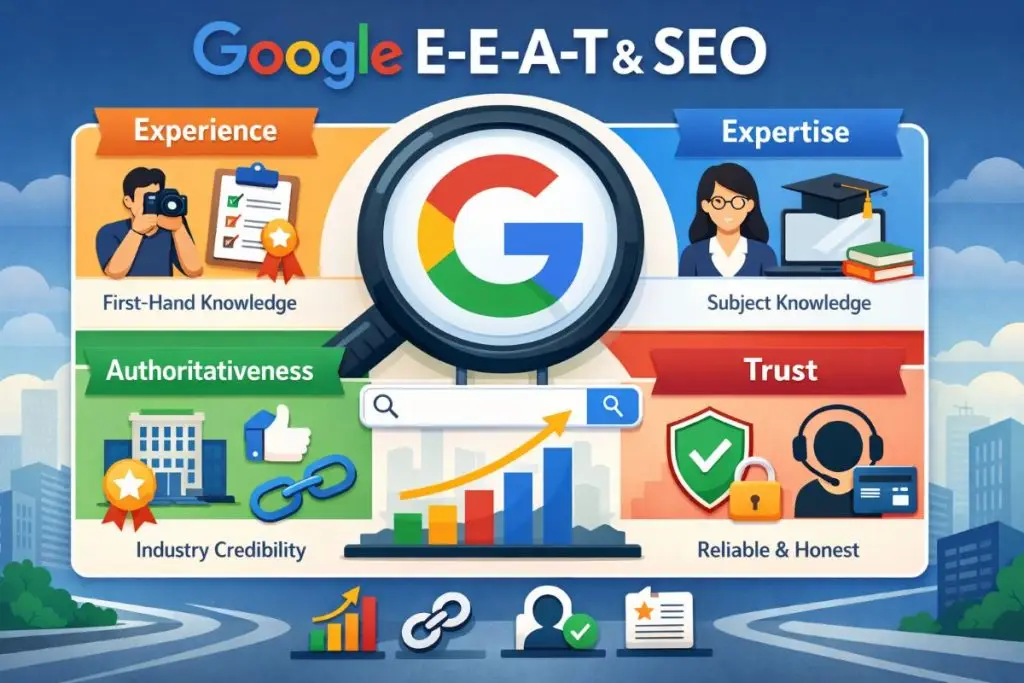
E-E-A-T stands for Experience, Expertise, Authoritativeness, and Trust. It is one of the most important ideas behind how Google evaluates content quality. Even though E-E-A-T is not a direct ranking factor in the simple sense of “add this to your page and rank higher tomorrow,” it strongly influences how content is assessed, especially in competitive and sensitive topics.
If you want to build a website that ranks well over time, you need to understand how E-E-A-T works and how to apply it across your content, website structure, brand presence, and publishing process.
In this guide, you will learn what E-E-A-T means, why it matters for SEO, how Google uses it, how it affects different types of websites, and what practical steps you can take to improve it. You will also find examples and a detailed checklist you can use for your own site.
What Is Google E-E-A-T?
Google introduced the concept of E-A-T years ago in its Search Quality Evaluator Guidelines. Later, it added another “E” for Experience, making it E-E-A-T.
Here is what each part means:
1. Experience
Experience refers to whether the content creator has first-hand, real-world involvement with the topic.
For example:
- A person reviewing a laptop after actually using it for three months shows experience.
- A traveler writing about a city they personally visited shows experience.
- A business owner sharing lessons from running Facebook ads for clients shows experience.
Google increasingly values content that demonstrates it comes from someone who has truly done the thing they are writing about.
2. Expertise
Expertise means the creator has knowledge or skill in the subject.
For example:
- A certified nutritionist writing about healthy meal planning shows expertise.
- An SEO specialist explaining technical SEO issues shows expertise.
- A skilled mechanic writing about engine maintenance shows expertise.
Not every article must be written by someone with a formal degree. In many topics, practical knowledge matters more than academic credentials. But the content should clearly show the creator understands the subject deeply.
3. Authoritativeness
Authoritativeness means the creator, website, or brand is recognized as a reliable source within its industry or topic.
For example:
- A well-known SEO blog that is frequently cited by other marketers has authority.
- A medical institution publishing health guidance has strong authority.
- A local law firm with positive reviews, press mentions, and expert legal articles can build authority in its niche.
Authority is often built over time through consistency, mentions, links, reviews, reputation, and quality content.
4. Trust
Trust is the most important part of E-E-A-T.
A page can show experience, expertise, and authority, but if users cannot trust it, the content is weak in Google’s eyes. Trust includes:
- Accurate information
- Honest claims
- Secure website
- Clear contact details
- Transparent authorship
- Reliable customer service
- Safe payment systems
- Good reputation
Google wants to rank content that users can safely rely on.
Why E-E-A-T Matters for SEO
Many website owners focus too much on keywords and ignore trust and credibility. That is a mistake.
Google’s goal is to give users the best answer, not just the page with the most repeated keyword. If two pages target the same keyword, the page with stronger E-E-A-T signals often has a better chance to perform well over time.
E-E-A-T matters because it helps Google answer questions like:
- Can this content be trusted?
- Does the author know what they are talking about?
- Is this website reputable?
- Is the information accurate and helpful?
- Would a user feel safe relying on this advice?
These questions matter even more in topics where bad information could harm people.
Is E-E-A-T a Direct Ranking Factor?
This is an important question.
E-E-A-T is not a direct ranking factor in the same way page speed, mobile usability, or crawlability might be measured. Google does not likely assign a simple score called “E-E-A-T = 87” and rank you based on that number.
Instead, E-E-A-T works more like a quality framework. Google’s systems try to identify signals that suggest trustworthy, helpful, expert-led content. These signals may include:
- Quality and accuracy of content
- Reputation of the site or author
- Quality backlinks and mentions
- Author information
- Reviews and public sentiment
- Clear policies and business details
- Content depth and usefulness
So while E-E-A-T may not be a direct ranking factor in a narrow technical sense, it absolutely impacts SEO performance because it aligns with what Google’s systems are designed to reward.
The Role of E-E-A-T in Google’s Quality Evaluation
Google has human quality raters who use Search Quality Evaluator Guidelines to assess search results. These raters do not directly control rankings, but their feedback helps Google improve its algorithms.
In those guidelines, E-E-A-T is a major concept used to judge page quality.
This tells us something very important:
Google wants its systems to rank content that reflects strong E-E-A-T. If your content looks thin, anonymous, unreliable, copied, or misleading, it may struggle, especially when competing against trusted brands and knowledgeable publishers.
Why Trust Is the Most Important Part
Among all four elements, Trust is the foundation.
Imagine this:
- A site looks professional.
- The writer seems experienced.
- The brand has some visibility.
But:
- The article includes misleading claims.
- There is no real contact information.
- The website hides who wrote the content.
- It makes unrealistic promises.
- Product pages have no refund or return policy.
That site may fail the trust test.
Trust matters because users need confidence that:
- The information is correct
- The advice is honest
- The business is real
- The content is not deceptive
- The website is safe to use
If Google detects low trust signals, rankings can suffer.
E-E-A-T and YMYL Topics
E-E-A-T becomes especially critical in YMYL topics.
YMYL means Your Money or Your Life. These are topics that can significantly affect a person’s:
- Health
- Finances
- Safety
- Happiness
- Legal situation
- Major life decisions
Examples of YMYL content:
- Medical advice
- Financial investment guidance
- Legal information
- Safety information
- Government or civic information
- Major shopping decisions
- Parenting advice in serious areas
- Mental health guidance
If your content falls into one of these categories, Google expects much stronger E-E-A-T.
For example:
- A health article on “symptoms of a heart attack” needs very strong trust and expertise.
- A blog post about “how to choose running shoes” still benefits from E-E-A-T, but the level of scrutiny is lower.
This means that if you run a finance, health, legal, or advice-based website, E-E-A-T is not optional. It is essential.
How E-E-A-T Impacts Rankings in Real Life
E-E-A-T influences rankings in a practical way through multiple signals that search engines can evaluate.
1. Better Content Quality Signals
When content is accurate, useful, well-structured, and written with genuine knowledge, it tends to perform better.
This can improve:
- User satisfaction
- Time on page
- Repeat visits
- Brand trust
- Natural backlinks
- Shares and mentions
These indirect signals support stronger SEO performance.
2. Higher Chance of Earning Backlinks
People are more likely to link to content they trust.
A detailed guide written by a real expert with examples and original insights is more link-worthy than a generic article rewritten from other blogs.
3. Stronger Brand Reputation
When your site becomes known as a reliable source, users search for your brand directly, cite your articles, and recommend your content. This strengthens your overall search visibility.
4. Improved Performance After Core Updates
Many websites that lose traffic after Google core updates often have weak quality, trust, or credibility signals. Strong E-E-A-T can help your site remain stable during algorithm changes.
5. Better Conversion Rates
E-E-A-T does not only affect rankings. It also affects whether users trust you enough to:
- Contact you
- Buy from you
- Subscribe
- Share your page
- Return later
This is why E-E-A-T matters for both SEO and business growth.
Example: Two Articles Target the Same Keyword
Let’s say two websites publish an article on “best laptops for graphic designers.”
Article A
- 1,200 words
- Generic advice
- No author bio
- No personal testing
- No comparison table
- No updated date
- No real images
- No evidence of expertise
Article B
- 3,500 words
- Written by someone who has used design software professionally
- Includes personal testing notes
- Compares laptop displays, RAM, GPU, battery life, and thermals
- Includes original screenshots or images
- Has clear author bio and publishing date
- Mentions who the article is best for
- Shows pros and cons from real use
Even if both pages target the same keyword, Article B is far more likely to demonstrate strong Experience, Expertise, and Trust. Over time, it has a better chance to rank, attract links, and satisfy users.
Example: Local Business and E-E-A-T
Imagine two local dental clinic websites.
Clinic Site 1
- Thin homepage
- No doctor profiles
- No patient reviews
- No contact transparency
- No services explained properly
- No blog
- Poor website security
Clinic Site 2
- Detailed doctor bios
- Clear qualifications
- Real clinic photos
- Service pages explaining treatments
- Patient testimonials
- FAQ pages
- Updated contact details
- Secure site
- Helpful blog articles on dental care
Clinic Site 2 sends far better E-E-A-T signals. It appears more trustworthy to both users and search engines.
Experience: Why First-Hand Knowledge Matters More Than Ever
The addition of “Experience” shows Google is paying more attention to content created by people who have genuinely used, tested, visited, tried, or done something.
This is especially important in:
- Product reviews
- Travel content
- Tutorials
- Service comparisons
- Personal case studies
- Real business lessons
How to show experience in content
You can demonstrate real experience by:
- Sharing what happened when you personally tested something
- Including original photos, screenshots, or data
- Mentioning specific challenges you faced
- Explaining what worked and what did not
- Giving practical tips that come from actual use
Example
A generic sentence:
This SEO plugin is very useful for WordPress websites.
A more experience-based sentence:
After using this SEO plugin on three small business WordPress websites, I found its schema settings easy for beginners, but its redirect manager was limited compared to dedicated redirection tools.
The second version sounds more real because it comes from actual use.
Expertise: How to Show You Know the Topic
You do not need to sound robotic or overly technical to show expertise. In fact, good expertise often means explaining complex ideas in a simple and accurate way.
Ways to demonstrate expertise
- Cover the topic deeply
- Explain concepts clearly
- Avoid factual mistakes
- Use examples
- Answer related questions users really have
- Update outdated information
- Reference trusted sources when needed
- Include author credentials where relevant
Example
If you write about SEO, expertise can be shown by:
- Explaining search intent correctly
- Discussing on-page SEO, technical SEO, internal linking, and content structure
- Avoiding outdated myths
- Giving actionable advice based on real-world work
Authoritativeness: How Sites Build Real Authority
Authority is not created overnight. It is built through repeated signals that show your site or brand is respected.
Signals that support authority
- Backlinks from relevant websites
- Mentions in trusted publications
- Positive brand reputation
- Strong niche content coverage
- Consistent publishing
- Recognized experts on the site
- Reviews and testimonials
- Industry citations
Important note
Authority is topic-based.
A site may be authoritative in one area but not another.
For example:
- A respected cooking blog may have authority on recipes
- That does not automatically make it authoritative on legal advice
To build authority, stay focused on your niche and publish content that strengthens your relevance over time.
Trust: How to Make Your Website More Reliable
Trust is built both on and off the page.
On-page trust signals
- Clear author name
- Accurate information
- Updated dates where relevant
- Easy-to-find contact page
- About page
- Editorial standards or content policy
- Secure HTTPS
- Honest claims
- Clear pricing and policies
Off-page trust signals
- Positive reviews
- Real business citations
- Good brand mentions
- Strong public reputation
- No spammy behavior
- No deceptive tactics
Trust killers
These can hurt trust badly:
- Fake reviews
- Anonymous advice on serious topics
- Misleading headlines
- Thin affiliate pages
- No business identity
- Excessive ads
- Low-quality AI-generated fluff without real value
- Copying content from other sites
- False expertise claims
How E-E-A-T Affects Different Types of Websites
E-E-A-T applies differently depending on the site type.
1. Blogs
Blogs need:
- Clear author identity
- Useful and original content
- Topic consistency
- Real examples
- Trustworthy information
Personal blogs can still rank well if they show real experience and helpfulness.
2. Affiliate Websites
Affiliate sites often struggle when they publish shallow product roundups without real testing.
To improve E-E-A-T:
- Add first-hand reviews
- Show testing process
- Include pros and cons
- Be transparent about affiliate relationships
- Avoid fake rankings
3. E-commerce Websites
Online stores need:
- Product accuracy
- Real customer reviews
- Secure checkout
- Return and refund policies
- Contact details
- Business transparency
Product pages should also provide helpful content, not just manufacturer text.
4. Service Business Websites
Agencies, freelancers, consultants, and local businesses need:
- Real client proof
- Service pages
- About page
- Testimonials
- Case studies
- Team bios
- Contact details
- Clear expertise
5. Health, Finance, and Legal Websites
These require the strongest E-E-A-T.
Use:
- Expert-reviewed content
- Accurate claims
- Professional credentials
- Updated information
- Strong reputation signals
Does E-E-A-T Matter for Small Websites?
Yes, absolutely.
Many small site owners think E-E-A-T only matters for big brands, but that is not true. In fact, small websites can compete well by showing real experience and depth.
A smaller niche site can outperform a larger brand if it:
- Covers the topic better
- Shows personal testing or case studies
- Answers user intent more clearly
- Builds trust through transparency
- Demonstrates genuine subject knowledge
For small websites, E-E-A-T is often a competitive advantage.
How to Improve E-E-A-T on Your Website
Now let’s move into practical action.
1. Create Helpful, Original Content
Do not rewrite what everyone else has already said. Add:
- Personal insights
- Examples
- Unique opinions
- Real data
- Step-by-step guidance
- Lessons from actual work
2. Add Strong Author Bios
Every important article should show who wrote it and why that person is qualified.
A good author bio may include:
- Name
- Role
- Experience
- Skills
- Relevant background
- Link to author page
3. Build Detailed About and Contact Pages
A real website should clearly show:
- Who runs it
- What the business does
- How users can reach you
- Why users should trust you
4. Use Real Examples and Case Studies
Examples increase both usefulness and credibility.
For instance:
- “We increased organic traffic by 62% in five months by improving internal links and updating outdated service pages.”
- “After testing five SEO audit tools, this one was easiest for beginners, but another one offered deeper crawl analysis.”
5. Keep Content Updated
Outdated content can damage trust. Review and refresh important pages regularly.
Update:
- Statistics
- Tools
- Screenshots
- Best practices
- Recommendations
- Dates where needed
6. Earn Quality Mentions and Links
Links from relevant, trustworthy sites can support authority. Focus on:
- Guest posts on relevant sites
- Digital PR
- Creating useful resources
- Publishing original research
- Building relationships in your niche
7. Show Reviews and Reputation Signals
If you are a business, make your reputation visible:
- Testimonials
- Review platform links
- Case studies
- Client logos
- Success stories
8. Improve Website Trust Signals
Make sure your site has:
- HTTPS
- Privacy policy
- Terms and conditions
- Refund or return policy if relevant
- Easy navigation
- Clear branding
- Fast loading pages
9. Avoid Thin Content
Thin content often fails E-E-A-T because it does not prove value or knowledge.
Weak page:
- Short
- Generic
- No depth
- No unique insight
- No author context
Stronger page:
- Comprehensive
- Useful
- Clear
- Original
- Practical
- Trustworthy
10. Focus on a Clear Niche
Topical relevance helps build authority.
If your site is about SEO, publish strong SEO content consistently instead of randomly mixing SEO, recipes, movies, and travel tips on the same domain.
A focused niche builds stronger topical trust.
Common Mistakes That Hurt E-E-A-T
Many websites fail not because they lack potential, but because they make avoidable mistakes.
Mistake 1: Publishing content with no real author
Anonymous content reduces trust, especially in serious topics.
Mistake 2: Writing about topics beyond your credibility
If your website is about general marketing and suddenly publishes medical advice, Google may not see that as trustworthy.
Mistake 3: Overusing AI without editing for quality
AI can help with drafting, but publishing generic, inaccurate, repetitive content without human review is risky.
Mistake 4: Making exaggerated claims
Claims like “Guaranteed #1 rankings in 7 days” damage trust.
Mistake 5: Having no proof
If you claim expertise, support it with:
- Examples
- Credentials
- Results
- Client work
- Real explanations
Mistake 6: Ignoring user intent
Even expert content can fail if it does not answer what users actually want.
A Simple E-E-A-T Audit Framework
You can audit any article or page using these questions:
Experience
- Does the content show first-hand knowledge?
- Are there real examples or original insights?
- Does it feel written by someone who has done this?
Expertise
- Is the information accurate and detailed?
- Does the writer clearly understand the topic?
- Are important points explained well?
Authoritativeness
- Is the site known in this niche?
- Are there mentions, links, reviews, or signs of reputation?
- Does the content align with the site’s core area of focus?
Trust
- Is the page honest, accurate, and transparent?
- Is the author or business clearly identified?
- Would a user feel safe relying on this information?
If too many answers are “no,” the page likely needs improvement.
Detailed Example: Improving E-E-A-T for an SEO Blog
Let’s say you run a blog about SEO and digital marketing.
Weak version
- Articles are 800 words
- No author bios
- Mostly rewritten from other blogs
- No screenshots
- No examples
- No internal linking strategy
- No service pages
- No case studies
Improved version
- Articles are in-depth and useful
- You explain things in simple language
- You add screenshots from Google Search Console or audits
- You share what worked on real websites
- You include author bios
- Your About page explains your SEO background
- You publish service pages for SEO consulting
- You show testimonials
- You link related blog posts together
- You update old content regularly
The improved version sends much stronger E-E-A-T signals and is more likely to build long-term visibility.
E-E-A-T and Content Writing Quality
Good content writing and E-E-A-T work together.
A well-written article should be:
- Clear
- Useful
- Easy to read
- Honest
- Structured around user intent
- Free of unnecessary repetition
- Focused on solving a problem
This is why keyword stuffing is harmful. It makes content sound unnatural and often reduces trust.
Instead of forcing the same phrase repeatedly, use natural language, related terms, examples, and clear explanations.
Google is smart enough to understand context. Your goal is not to repeat keywords as many times as possible. Your goal is to create the best page for the user.
Best Practices for Writing E-E-A-T-Friendly Content
Here are strong writing practices that support E-E-A-T:
Write for people first
Answer the real question behind the keyword.
Use a clear structure
Break content into logical sections with headings and subheadings.
Add examples
Examples make your advice easier to trust and understand.
Be specific
Vague content feels weak. Specific content feels credible.
Avoid fake certainty
If something depends on context, say so honestly.
Explain the “why”
Do not just tell users what to do. Explain why it matters.
Use plain language
Simple writing often shows real understanding better than complicated writing.
Edit carefully
Grammar, clarity, and accuracy all affect trust.
E-E-A-T Checklist
Use this checklist before publishing or updating a page.
Content Quality Checklist
- Is the content original and genuinely helpful?
- Does it fully answer the user’s question?
- Is the writing clear and easy to understand?
- Have you avoided keyword stuffing?
- Did you include examples where this is useful?
- Is the information accurate and up to date?
Experience Checklist
- Does the content reflect first-hand experience?
- Have you included personal insights, screenshots, or real examples?
- Does the article show practical understanding?
Expertise Checklist
- Is the article written or reviewed by someone knowledgeable?
- Is the topic explained deeply and correctly?
- Are important details covered, not skipped?
Authority Checklist
- Does the website focus on this niche?
- Do you have related content supporting topical depth?
- Has the page or site earned mentions, links, or trust signals?
Trust Checklist
- Is the author clearly identified?
- Is the website secure with HTTPS?
- Are contact details easy to find?
- Do you have an About page?
- Are claims realistic and honest?
- Are business policies visible if relevant?
- Does the page avoid misleading headlines?
Website-Level Checklist
- Is navigation clear?
- Are pages fast and mobile-friendly?
- Are there spammy ads or distractions?
- Is branding consistent and professional?
- Are there low-quality pages that should be improved or removed?
Quick Example Checklist for a Product Review Page
If you publish a review article like “Best Budget Laptops for Students,” ask:
- Did I actually test these laptops or research them deeply?
- Did I explain who each laptop is best for?
- Did I mention drawbacks, not just positives?
- Did I include comparison points like battery, display, and performance?
- Did I explain how I chose the products?
- Did I show real experience or practical insight?
- Would a reader trust this page enough to make a buying decision?
If the answer is yes, your E-E-A-T is likely stronger.
Can Great E-E-A-T Alone Guarantee Rankings?
No. E-E-A-T is important, but it does not replace core SEO basics.
You still need:
- Strong keyword targeting
- Search intent matching
- Good on-page SEO
- Technical SEO health
- Internal linking
- Crawlability
- Mobile usability
- Backlinks
- Content relevance
Think of it this way:
SEO helps Google find and understand your content.
E-E-A-T helps Google trust your content.
You need both.
The Long-Term SEO Benefit of E-E-A-T
Many site owners chase fast SEO wins. E-E-A-T is different. It is a long-term strategy.
When you invest in trust, expertise, and experience:
- Your content becomes harder to copy
- Your brand becomes more memorable
- Users trust you more
- Your site is more resilient after updates
- Conversion rates often improve
- Your authority grows naturally over time
This is why E-E-A-T is not just an SEO idea. It is a content and brand strategy.
Final Thoughts
Google E-E-A-T matters because search engines want to rank content that people can rely on. Experience shows you have done the work. Expertise shows you understand the topic. Authoritativeness shows others recognize your value. Trust proves your content and website are safe, honest, and dependable.
If you want better SEO results, do not focus only on keywords. Focus on becoming the kind of website Google wants to recommend and users want to trust.
That means:
- Publish helpful, original content
- Show real experience
- Demonstrate expertise
- Build your authority in a clear niche
- Make your website transparent and trustworthy
In the end, strong E-E-A-T is not about trying to look credible. It is about actually being credible.
When your website consistently helps people with accurate, useful, experience-based content, SEO becomes much stronger and more sustainable.
Get A Free Website Audit
FAQ
What does E-E-A-T stand for in SEO?
E-E-A-T stands for Experience, Expertise, Authoritativeness, and Trust. It is a framework Google uses to evaluate content quality and reliability.
Is E-E-A-T a direct Google ranking factor?
E-E-A-T is not usually described as a direct ranking factor with a single measurable score. However, it strongly influences the kinds of content Google wants to rank.
Why is trust the most important part of E-E-A-T?
Trust matters most because inaccurate or misleading content can harm users. If a page is not trustworthy, the other parts of E-E-A-T become much less valuable.
Does E-E-A-T matter for small websites?
Yes. Small websites can build strong E-E-A-T by publishing helpful niche content, showing real experience, and being transparent about who they are.
How can I improve E-E-A-T on my website?
You can improve E-E-A-T by adding author bios, publishing original content, sharing real examples, building topical authority, earning quality links, and making your website more trustworthy.
Does E-E-A-T matter more for some topics than others?
Yes. It matters especially for YMYL topics such as health, finance, legal advice, and safety-related content, where inaccurate information can seriously affect users.