
Table of Contents
ToggleContent Gap Analysis: How to Find What Your Website Is Missing
Publishing more content does not always lead to better results. Many websites keep adding blog posts, landing pages, and category pages but still struggle to grow traffic, leads, or sales. The problem is often not effort. The problem is missing the right content.
That is where content gap analysis becomes valuable.
A content gap analysis helps you find the topics, questions, keywords, and search intents your audience cares about but your website does not cover well yet. It also shows where competitors are winning attention because they already have pages that answer those needs better than you do.
This process is not just for large brands with big SEO teams. It is useful for bloggers, affiliate sites, local businesses, SaaS companies, eCommerce stores, agencies, and service providers. If your website is not attracting enough relevant visitors, a content gap analysis can show you what is missing and what to create next.
In this guide, you will learn what content gap analysis means, why it matters, how to do it step by step, which tools can help, and how to turn the findings into pages that actually support business growth.
What Is Content Gap Analysis?
Content gap analysis is the process of identifying missing or weak content on your website compared with what your target audience is searching for and what competing websites already provide.
In simple words, it answers questions like these:
-
What topics does my audience want that I have not covered yet?
-
Which keywords do competitors rank for that I do not?
-
Which pages do I have, but they are too weak, outdated, or incomplete?
-
What stage of the customer journey am I ignoring?
-
What type of content is missing, such as guides, comparisons, FAQs, case studies, or product pages?
A gap does not always mean “no content exists.” Sometimes the gap is depth. Sometimes it is search intent. Sometimes it is formatted. You may already have an article on a topic, but if it is too short, too generic, outdated, or not aligned with what users want, it is still a gap.
Why Content Gap Analysis Matters
Many websites create content based on random ideas, trends, or assumptions. That usually leads to content that looks active but performs poorly. Content gap analysis brings direction.
Here is why it matters:
1. It helps you find missed traffic opportunities
There are often dozens or hundreds of relevant search queries your audience uses that your site does not target. When you find these gaps, you can build pages that bring in qualified traffic instead of guessing what to write.
2. It improves topical authority
When your website covers a subject fully and clearly, search engines can better understand your expertise. A site with scattered articles looks weaker than a site with strong topic coverage.
3. It supports the full customer journey
Many websites only write top-of-funnel blog posts and ignore middle- and bottom-of-funnel content. That means they may attract readers but fail to convert them. A proper gap analysis uncovers missing comparison pages, service pages, product pages, and decision-stage content.
4. It makes content planning smarter
Instead of writing ten weak articles, you can focus on the few topics that fill real gaps and support your goals. This saves time, budget, and energy.
5. It improves existing content as well as new content
Not every gap requires a new page. Sometimes the best move is updating an existing article with better structure, examples, internal links, visuals, or clearer intent matching.
Types of Content Gaps
Not all content gaps are the same. Understanding the type of gap makes your action plan much stronger.
Topic gaps
These are subjects your audience cares about that your site does not cover at all.
Example: A digital marketing blog writes about SEO basics but has no content on technical SEO, local SEO, or SEO audits.
Keyword gaps
These are search queries competitors rank for but your site does not.
Example: Your competitors rank for “content gap analysis template” and “content gap analysis example,” but you have no pages targeting those searches.
Intent gaps
These happen when your content exists but does not match what the searcher wants.
Example: A user searches for “best email marketing tools,” but your page gives only definitions instead of a real comparison.
Format gaps
Sometimes the topic is covered, but not in the format users prefer.
Example: You have a general article, but users want a checklist, comparison table, FAQ section, tool roundup, or case study.
Funnel gaps
These appear when you only cover one stage of the buyer journey.
Example: You have informational blogs but no pricing page, service page, case study, or product comparison content.
Freshness gaps
Your content may once have been useful, but now it is outdated.
Example: A post from two years ago still ranks on page two, but it references old tools, broken links, and outdated practices.
Signs Your Website Has Content Gaps
You do not need a full audit to suspect a gap problem. Common signs include:
-
Your competitors rank for many terms you do not
-
Your traffic grows slowly even though you publish often
-
Visitors read blog posts but do not convert
-
Important service or product pages get little visibility
-
Your articles cover broad topics but not specific questions
-
Several pages compete with each other without ranking well
-
You rely too much on a few posts for most of your traffic
If any of these sound familiar, content gap analysis should become part of your strategy.
How to Do a Content Gap Analysis Step by Step
A strong content gap analysis is not just a keyword export from a tool. It needs business context, audience understanding, and content judgment.
Step 1: Define your goals
Before looking at keywords, decide what success means for your website.
Your goals may include:
-
More organic traffic
-
Better-quality leads
-
More product or service inquiries
-
Stronger topical authority
-
Better rankings for commercial pages
-
Improved internal linking across a content cluster
Without a goal, it is easy to collect a large list of keywords and create content that does not move your business forward.
Step 2: Understand your audience and search intent
Think about who you want to attract and what they need at different stages.
Ask:
-
What problems are they trying to solve?
-
What questions do they ask before buying?
-
What comparisons do they search?
-
What objections do they have?
-
What information helps them trust a brand?
A content gap is only useful if it matters to the right audience. Not every missing keyword deserves attention.
Step 3: Audit your existing content
Create a content inventory of your current pages. This can be a spreadsheet with columns like:
-
URL
-
Page title
-
Main topic
-
Search intent
-
Funnel stage
-
Current traffic
-
Backlinks
-
Conversions
-
Last updated date
-
Notes on quality
This helps you see what you already have, where pages overlap, and where you are thin or outdated.
During this step, look for:
-
Articles with weak depth
-
Pages targeting the wrong intent
-
Duplicate topic coverage
-
Missing internal links
-
Old posts worth updating instead of replacing
-
Important pages with no supporting content
Step 4: Identify your real competitors
Your business competitors are not always your SEO competitors.
For content gap analysis, focus on websites that rank for the same topics and audience queries you want to target. A small niche blog may be a more important SEO competitor than a large brand if both appear for the same searches.
Choose a few competitors that are relevant, not just popular.
Step 5: Compare keyword visibility
Now compare your site against competitor sites to find keywords and topics they rank for that you do not.
This is where a content gap analysis tool becomes helpful. Many SEO platforms let you enter your domain and competitor domains to see keyword overlaps and missing terms.
But do not stop at the raw list. A gap list alone can become noisy. You need to review each opportunity through these questions:
-
Is this keyword relevant to my audience?
-
Does it match my offer or expertise?
-
What is the intent behind the query?
-
Would I need a new page or an improved page?
-
Can this topic support traffic and conversions?
Step 6: Analyze the search results manually
Tools are useful, but the search results reveal the real intent.
For each promising topic, review the pages that rank well and look for patterns:
-
Are they guides, product pages, or list posts?
-
Do they include tools, examples, visuals, or templates?
-
How deep is the coverage?
-
Are results mostly informational or commercial?
-
What subtopics appear across the top pages?
This step helps you avoid creating the wrong type of content.
Step 7: Find missing subtopics and questions
A page may target the right main keyword but still underperform because it misses important subtopics.
For example, if you write about content gap analysis, users may also expect:
-
definition
-
benefits
-
step-by-step process
-
tools
-
example
-
mistakes
-
FAQ
If your article skips these, it may feel incomplete compared with stronger competing pages.
This is why content gap analysis is not only about keywords. It is also about completeness.
Step 8: Prioritize the gaps
You will probably find more opportunities than you can handle at once. Prioritize them based on:
-
Relevance to your audience
-
Business value
-
Ranking potential
-
Competition level
-
Content effort required
-
Internal linking value
-
Funnel importance
A smaller high-intent topic can be more valuable than a large low-intent one.
Step 9: Decide whether to create, update, merge, or delete
Your action for each gap may be different:
-
Create a new page if the topic does not exist
-
Update a page if the topic exists but is weak
-
Merge pages if several thin articles compete on the same topic
-
Delete or redirect pages that add confusion or no value
This is where strategy matters more than volume.
Step 10: Track results and refine
After publishing or updating pages, monitor performance.
Look at:
-
rankings
-
impressions
-
clicks
-
time on page
-
conversions
-
internal link impact
-
keyword spread across the topic cluster
A good content gap analysis is not a one-time task. It should become part of your ongoing content process.
Best Content Gap Analysis Tools
There is no single perfect tool. The best choice depends on your budget, workflow, and how deeply you want to analyze content opportunities.
1. Ahrefs
Ahrefs is widely used for competitor keyword analysis. Its Content Gap feature helps you compare your domain with competitors and find keywords they rank for while you do not.
Good for:
-
competitor keyword comparison
-
topic discovery
-
ranking gap analysis
-
content opportunities at scale
2. Semrush
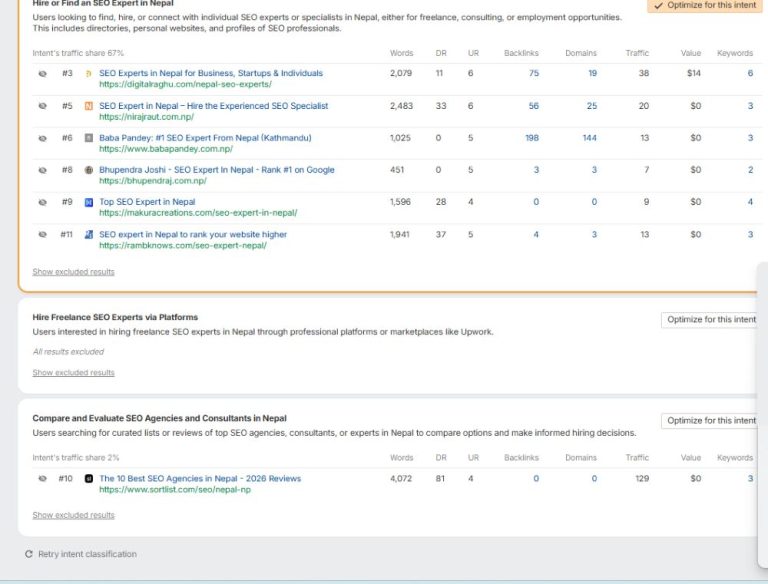
Semrush also offers strong keyword gaps and competitive research features. It is useful for finding shared, missing, weak, and untapped keyword opportunities.
Good for:
-
keyword gap reports
-
content planning
-
competitor research
-
topic clustering support
3. Google Search Console
This is free and highly valuable. While it does not compare competitor domains, it shows queries where your pages already get impressions but underperform. That often reveals update opportunities.
Good for:
- finding low-hanging fruit
- improving existing pages
- spotting intent mismatch
discovering pages close to ranking better
4. Google Search Results
Manual SERP review is still one of the most useful “tools.” It helps you see what format, structure, and depth search engines are rewarding.
Good for:
- intent analysis
- content format review
- subtopic discovery
- understanding real competition
5. Answer-based tools and forums
Platforms that surface common questions can help you find user language and pain points. These are useful for FAQ ideas, long-tail topics, and supporting subtopics.
Good for:
- question discovery
- pain point research
- supporting sections
- audience language
- finding low-hanging fruit
Content Gap Analysis Example
Let’s say you run a website that offers SEO services for small businesses.
You already have these pages:
- Home page
- SEO services page
- Blog post on “What is SEO?”
- Blog post on “On-page SEO basics”
- Blog post on “How to do keyword research”
At first glance, that may seem fine. But after a content gap analysis, you notice competitors are getting traffic from pages like:
- local SEO checklist
- technical SEO audit guide
- SEO pricing for small businesses
- local SEO vs traditional SEO
- how long SEO takes
- common SEO mistakes for small businesses
- SEO case studies
- website audit service page
Now the gaps become clear.
Gap 1: Missing bottom-of-funnel content
You have educational articles, but no pages targeting users close to hiring someone. That means you attract learners, not buyers.
Action: Create pages such as:
- SEO audit service
- SEO pricing guide
- local SEO service page
- SEO case study page
Gap 2: Missing local intent content
If you serve businesses in a location, but your content is too broad, you miss local relevance.
Action: Build local SEO pages or city-specific service pages where appropriate.
Gap 3: Weak trust-building content
Competitors use examples, results, and proof. Your site only has basic information.
Action: Add case studies, process explanations, expected timelines, and clear outcomes.
Gap 4: Missing supporting cluster content
Your service pages do not have enough related informational content pointing to them.
Action: Write supporting articles like:
- how to improve Google Business Profile visibility
- local citation mistakes
- signs your small business needs an SEO audit
This example shows that content gap analysis is not just about “more blogs.” It is about finding missing content that supports visibility and conversions together.
Common Mistakes in Content Gap Analysis
A lot of people do the research but still get weak results because of avoidable mistakes.
Chasing every missing keyword
Not every keyword matters. Some are irrelevant, low-value, or too far from your actual audience. Focus on useful gaps, not all gaps.
Ignoring search intent
A keyword may look attractive, but if the ranking pages show a different intent than your content, your page may never perform well.
Creating thin copy just to fill a gap
A gap should be filled with meaningful content, not shallow text added for the sake of completeness. Weak pages do not build authority.
Forgetting conversion value
Traffic alone is not enough. Some gaps are informational and useful. Others directly support leads or sales. A balanced strategy matters.
Not updating existing pages
Sometimes the best opportunity is not a new article but a stronger version of an existing one.
Using tools without human judgment
A tool can show missing terms, but it cannot fully decide what is worth creating for your audience and business model.
How to Turn Gap Findings Into Strong Content
Once you know what is missing, the next step is execution. Good analysis means little without strong writing and page structure.
When creating new pages, focus on:
- clear purpose
- strong introduction
- useful depth
- logical headings
- real examples
- audience-centered language
- clean internal linking
- direct answers to important questions
- original insight where possible
Write to solve a problem, not to repeat definitions in different words. Readers can feel when content exists only to target a keyword.
A strong page should leave the visitor feeling informed, clear, and ready for the next step.
When to Do a Content Gap Analysis
You do not have to wait for a traffic drop. Good times to do one include:
- before building a content calendar
- After launching a new website Content gap analysis is one of the most practical ways to improve a website’s content strategy. It helps you move away from random publishing and toward intentional growth.
Instead of asking, “What should I write next?” you begin asking better questions:
- What is my audience still not finding on my site?
- Where are competitors serving that need better?
- Which missing pages can help both traffic and conversions?
- Which current pages deserve improvement instead of replacement?
That shift matters.
When done well, content gap analysis helps you create content with purpose. It reveals what is missing, what is weak, and what should come next. It also helps you build a site that feels more complete, more useful, and more aligned with what real users want.
The best results do not come from filling every gap. They come from filling the right ones with content that is specific, helpful, and built to serve both readers and business goals.
- when competitors keep outranking you
- before updating old content
- when expanding into a new service or category
- after traffic growth stalls
- when you want better topical coverage
Quarterly or biannual reviews work well for many websites.
conclusion
Content gap analysis is one of the most practical ways to improve a website’s content strategy. It helps you move away from random publishing and toward intentional growth.
Instead of asking, “What should I write next?” you begin asking better questions:
- What is my audience still not finding on my site?
- Where are competitors serving that need better?
- Which missing pages can help both traffic and conversions?
- Which current pages deserve improvement instead of replacement?
That shift matters.
When done well, content gap analysis helps you create content with purpose. It reveals what is missing, what is weak, and what should come next. It also helps you build a site that feels more complete, more useful, and more aligned with what real users want.
The best results do not come from filling every gap. They come from filling the right ones with content that is specific, helpful, and built to serve both readers and business goals.
What is content gap analysis in SEO?
Content gap analysis in SEO is the process of finding topics, questions, keywords, or search intents your website does not cover well but your audience is searching for. It often includes comparing your site with competitors and improving weak or missing pages.
Which is the best content gap analysis tool?
There is no single best tool for everyone. Ahrefs and Semrush are strong options for competitor keyword comparison. Google Search Console is excellent for finding opportunities on your own site. The best choice depends on your budget and workflow.
Is content gap analysis only for blog posts?
No. It can be used for blog posts, service pages, product pages, category pages, landing pages, help content, and FAQs. In many cases, the most important gaps are not blog topics but conversion-focused pages.
How often should I do a content gap analysis?
For many websites, every three to six months is a practical schedule. You can also do it when traffic slows, when entering a new niche, or before planning a new content campaign.
What is the difference between keyword gap and content gap?
A keyword gap is usually narrower and focuses on search queries competitors rank for that you do not. A content gap is broader and includes missing topics, missing intent coverage, weak page depth, outdated content, and funnel gaps.